Vilnius is not a city you will understand merely by visiting its sights. You will understand it by walking its streets, because it is here that history, culture, food, and nightlife intertwine. This guide will help you not only navigate but also feel the city's pulse. Here are the main streets worth not just walking through, but truly "experiencing."
Pilies Street: The Oldest Face of Vilnius

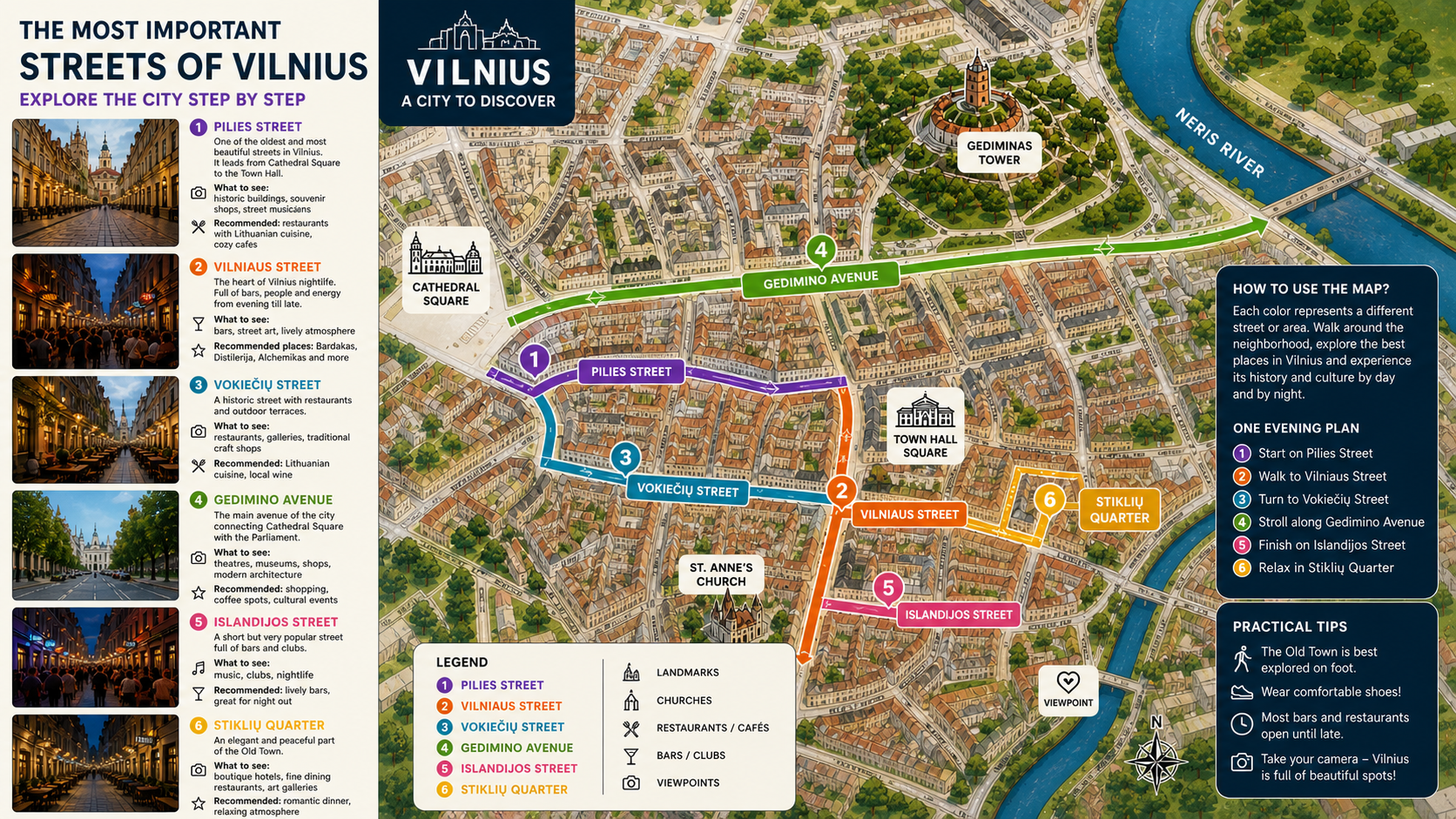
Pilies Street is a Vilnius classic. It is the oldest and one of the most beautiful streets in the entire Old Town. It connects Cathedral Square with Town Hall Square and appears like a postcard to every first-time visitor: cobblestone pavement, facades from different centuries, cozy cafes.
The street is full of souvenir shops, small restaurants, and historical buildings. In summer, the sounds of street musicians always fill the air, and in winter, it transforms into a romantic pathway with lanterns and Christmas trees in the surrounding squares.
What to experience here:
- Wander aimlessly, as it's the most beautiful street to "get lost" in.
- Visit a Lithuanian cuisine restaurant. Classics include cepelinai, šaltibarščiai in summer, and fried bread.
- Stop and listen to street musicians, as they are always present here.
Pilies Street is the "first impression of Vilnius," and usually, it's a very good one.
Vilniaus Street: The Heart of Bars and Nightlife

Vilniaus Street is a completely different Vilnius. If Pilies Street is history, this one is energy. This is where the city's true nightlife begins. Bars stand side by side, people move from one place to another, and the spontaneous "where next?" atmosphere is a natural part of this district.
An especially important spot is the intersection with Islandijos Street. This is one of the liveliest points of Vilnius nightlife, where most evenings typically begin.
Places worth knowing:
- Bardakas: chaotic, lively, a symbol of "Vilnius night." A youthful crowd, with a buzz that lasts into the late hours.
- Distilerija: for stronger drinks, whiskey and gin lovers. Suitable for an evening without much noise.
- Alchemikas: a benchmark of Vilnius cocktail culture. Professional mixology, attention to detail, rated 4.7 out of 5.
If you want to experience Vilnius nightlife, start here.
Vokiečių Street: History and Food in One Place

Vokiečių Street is one of Vilnius' oldest arteries, which today has become a place for food and gatherings. Here, there's less of a tourist "wow" effect, but more of real local life, outdoor restaurant terraces, and a slow pace.
The street is wide, making it a great place for outdoor dining, especially in summer. The selection of restaurants is extensive, ranging from Lithuanian cuisine to Italian, South Asian, or modern European.
What to do here:
- Dine on an outdoor terrace during the warmer months.
- Try different cuisines in one evening, strolling from terrace to terrace.
- Observe the city without rushing, as the pace naturally slows down here.
This is a street where Vilnius becomes "lived in," not just visited.
Gediminas Avenue: The Spine of Vilnius

Gediminas Avenue is the city's main artery, connecting the Cathedral with the Parliament. This is where official Vilnius happens, where business, politics, and culture meet. On weekends, some sections of the avenue become almost pedestrian-only.
Unlike the Old Town, Vilnius feels more modern here: wide sidewalks, facades from the late 19th and early 20th centuries, public transport flow, and numerous cafes with large windowed facades.
What to see here:
- Theaters and museums, including the Lithuanian National Drama Theater.
- Shops and cafes, where locals typically gather.
- The city's daytime rhythm, which differs greatly from the Old Town's vibrancy.
Islandijos Street: Small Area, Big Energy
Islandijos Street is like Vilnius' "mini Soho." It is short but very intense: bars, clubs, music, and a flow of people that only increases towards the evening.
It directly connects with Vilniaus Street, so people usually move between both streets. This is a place where evening often turns into night imperceptibly.
Stiklių Quarter: Elegant Vilnius

If you want to see a different Vilnius, calmer and more elegant, head to Stiklių Street. This is a small quarter, famous for its luxury restaurants, boutique hotels, and cozy atmosphere.
Here, Vilnius becomes slower, more refined. The streets are narrow, facades have been preserved since the 18th century, and inner courtyards often hide the best dinner tables in the city.
How to Combine Everything into One Itinerary
If you have one evening in Vilnius, do this:
- Start with Pilies Street, for history and a first impression.
- Move to Vokiečių Street, for dinner on an outdoor terrace.
- Head towards the intersection of Vilniaus and Islandijos Streets, for nightlife.
- The next day, Gediminas Avenue, the modern city center in daylight.
- For the evening, Stiklių Quarter, a refined conclusion.
This is not a typical tourist route. This is the real Vilnius, as locals know it.
Summary
Vilnius consists not only of buildings but also of streets, each telling its own story. Pilies will show you the past, Vilniaus and Islandijos the energy, Vokiečių and Stiklių Quarter the flavors, and Gediminas Avenue the rhythm of the present. One trip is usually not enough to get to know them all, but it is enough to fall in love with the city.
You can find more practical information in our 3-day itinerary guide and guide on how to get to Vilnius from the airport.