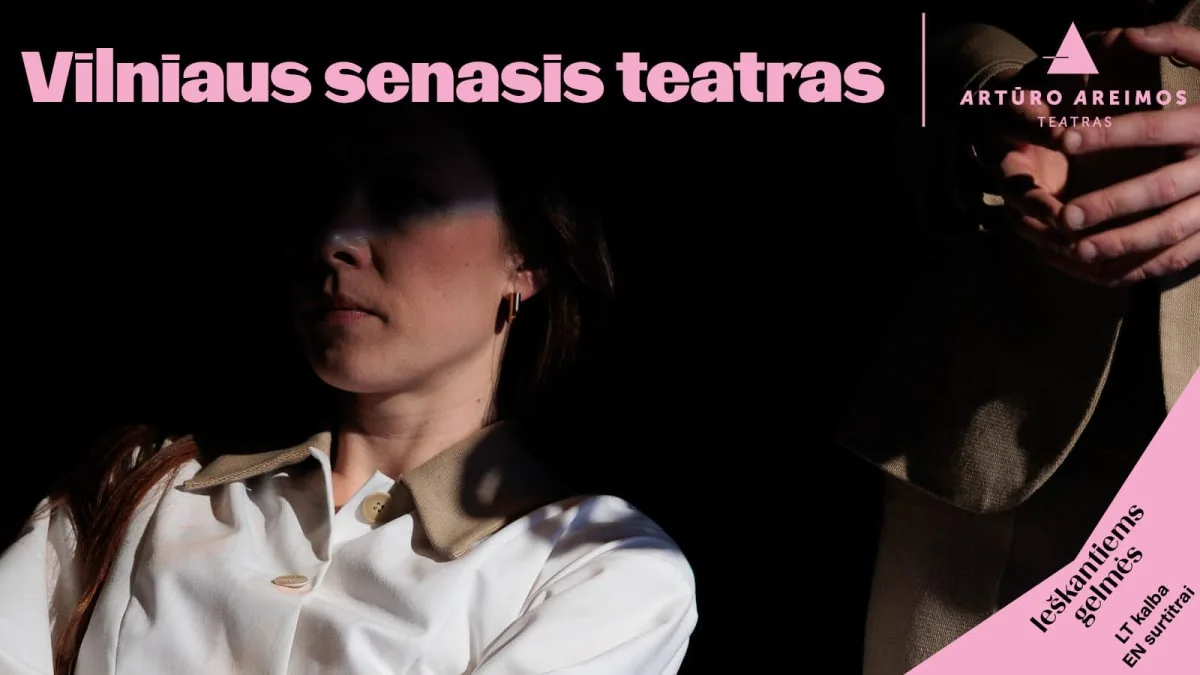
“JERMA” after Federico García Lorca, directed by Artūras Areima
theaterAbout
“Jerma”
After Federico García Lorca. Drama. Running time: 2 hours (no interval). Premiere: May 7 and 8, 2026. Performed in Lithuanian with English surtitles. Small Hall.
Creative team: director, set designer, and adaptation author – Artūras Areima; costume designer – Valdemara Jasulaitytė; lighting designer – Julius Kuršys; composer – π (Monika Poderytė); assistant director – Eglė Kuzienė; Federico García Lorca’s poems translated from Spanish by Henrikas Bakanas.
Cast: Jerma – Eglė Špokaitė; Marija – Eglė Grigaliūnaitė; Desmina – Juliana Volodko; Elena – Liuda Gnatenko; Robertas, psychiatrist – Artur Svorobovič; Viktoras – Aleksandr Kanajev / Viačeslav Lukjanov.
“Jerma” is a play about cooling relationships, a demanding body, love that no longer offers trust, motherhood without embellishment, and the courage to acknowledge what is often left unsaid. Artūras Areima’s production, based on Federico García Lorca’s play “Jerma” (Spanish: “Yerma”), examines reproduction and the tension between society’s expectations and pressure to have children and an individual’s freedom to create their own life. It reveals different faces and contradictions of motherhood: the helplessness of being unable to have children, and the exhaustion and danger of losing oneself after having them.
Areima adapted the play written in 1934, bringing its vocabulary, moral dilemmas, and themes into a contemporary context. It tells the story of a young woman burdened by the social stigma surrounding a childless marriage. Jerma is obsessed with having a child so she can meet what she believes to be society’s proper standard. The play addresses the body beginning to dictate more than the mind; love that does not fit within the confines of a couple; motherhood as desire, God, illness, and protest; and the desire to feel meaning when other sources of meaning in life no longer work.
The creative team raises questions about reproduction’s relationship to identity, society’s role, and fulfilment in life; the experiences of couples unable to have children or who have experienced miscarriage; and the sources of social pressure.
Federico García Lorca (1898–1936) was a Spanish poet, playwright, and prose writer, called one of the great innovators of 20th-century poetic and dramatic form, although he did not consciously pursue that aim. He supported the disadvantaged and marginalized. He died under mysterious circumstances during the Spanish Civil War. He called himself a proponent of social theatre; his plays feature the Greek tragedy problem of fate, doubt about the progress of European civilization, anxiety, spiritual tension, and fear of impending danger and violent death.
“Jerma” is part of the trilogy “Blood Wedding,” “Jerma,” and “The House of Bernarda Alba.” In 1992, the play was staged at the National Kaunas Drama Theatre and Juozas Miltinis Drama Theatre.
Artūras Areima is a Lithuanian theatre creator of the middle generation. Since 2017, he has been a candidate for the European Theatre Convention’s “New Theatrical Realities” award. In 2013, he received the Boris Dauguvietis Earring for searching for new forms of stage expression; he was nominated for the Golden Stage Cross in the director category in 2013, 2014, and 2015. He founded his namesake theatre in 2014; his productions have been presented at prominent theatre festivals in Europe and Asia.
JERMA
“I am afraid of being only a body you sometimes remember. I want a body that creates another body. I want something to grow inside me, not only thoughts and fears.”
A co-production of Vilnius Old Theatre and VšĮ “Artūro Areimos teatras.” The project is funded by the Lithuanian Council for Culture.
Details
Date
December 17, 2026
Location
Vilniaus senasis teatras
Price
nuo 26.10 €