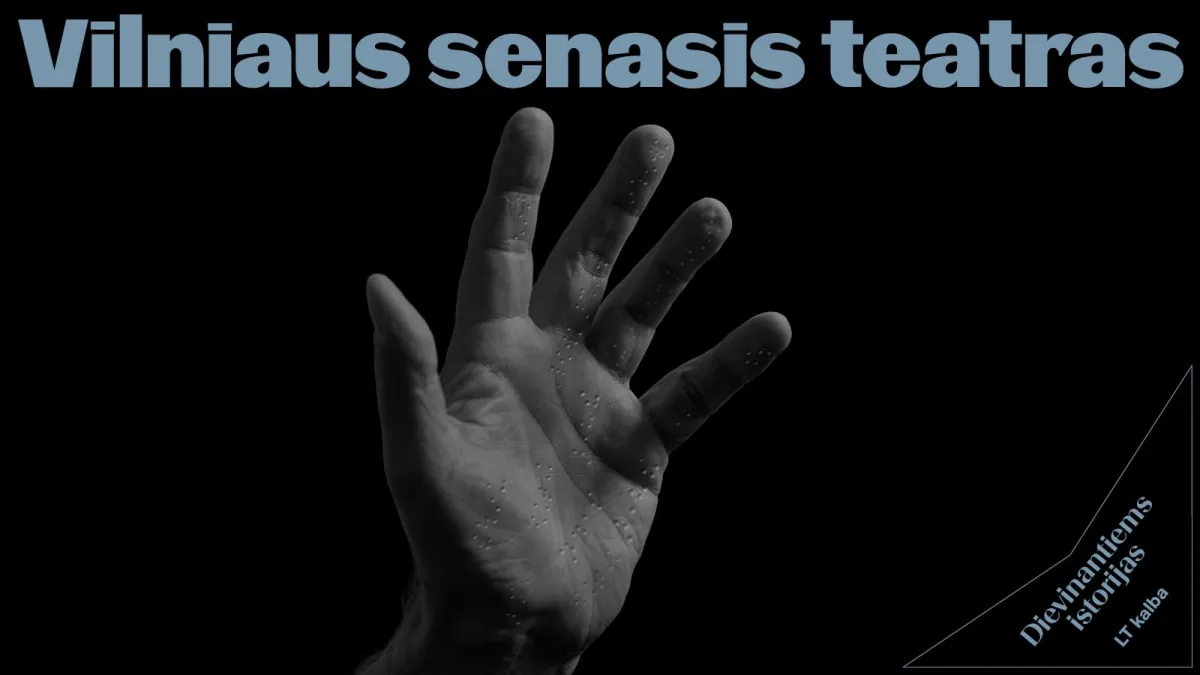
Rasa Bugavičute-Pēce “THE ONE WHO SAW IN THE DARK” (Dir. Rolandas Atkočiūnas)
theaterAbout
Rasa Bugavičute-Pēce
“The One Who Saw in the Dark”
A play in one act
Duration: 2 hr 10 min.
Premiere: 10 and 11 October 2026
The play is in Lithuanian
This play is based on the book The Boy Who Saw in the Dark (Latvian: Puika, kurš redzēja tumsā) by Rasa Bugavičute-Pēce, a Latvian writer and playwright of Lithuanian descent.
This is the story of Jokūbas: a boy, then a young man, and later a mature man whose parents are blind. It is the story of a person who tries to understand the world so that others can live in it. Jokūbas's mother (Zelma) and father (Lionginas) are blind. There are other blind people living in the dormitory, too. From an early age, the boy became their eyes. Blindness is not an illness, much less a tragedy; it is an existential condition.
Responsibilities and worries fall on Jokūbas at an early age. He is different everywhere: both in the sighted community and among blind people. But he knows how to love, he grows and matures, and contradictions accompany him, as do the joys of everyday life.
The play does not ask what it means to be blind. It asks what it means to see. Is it a gift or a burden? How can a person grow when they have had to be an adult from the very beginning? What marks are left by a close bond that is both love and dependence?
R. Bugavičute-Pēce grounds her work in observing social reality and in documentary sensitivity. In her plays, the human voice is paramount: authentic, living speech that records what people tend to leave unsaid or, at best, say only in guarded terms.
The story and characters of The One Who Saw in the Dark have counterparts in real life. The production is close to documentary theatre, or at least comes close to it.
“The darkness in this play is not negative. Jokūbas saw in the dark—he saw what others could not. Love and burden can live in one person and coexist. That is what theatre is needed for: to understand this; theatre can do that.” (Rolandas Atkočiūnas)
“This story is not about seeing or not seeing, but about what can be perceived without the eyes. About what matters most.” (Bārbala Simsonė)
///
Rasa Bugavičute-Pēce is a Latvian playwright and prose writer of Lithuanian descent, and an author of film and television-series screenplays. She received the International Jānis Baltvilks Prize (2020). The Boy Who Saw in the Dark (2019) is her second book. The book was included in the international literary catalogue White Ravens for 2020 and shortlisted for the European Union Prize for Literature in 2021. The production of The Boy Who Saw in the Dark at the Latvian National Theatre (dir. Valters Sīlis) was named the best production of the 2019–2020 season.
Rolandas Atkočiūnas is a theatre director. In 1992, he founded Kaunas Small Theatre, where he worked as artistic director for two years. From 1994, he worked at Šiauliai Drama Theatre (as director, artistic director and theatre director). From 2005 to 2008, he worked at Liepāja Drama Theatre (Latvia) as director and artistic director. In 2011–2012, he was artistic director of Juozas Miltinis Drama Theatre. Atkočiūnas is more drawn to existential, metaphysical and intimate theatre; he is interested in stage interpretations of contemporary and 20th-century modern drama and explores sharp themes relevant to contemporary society. His most recent productions are T. Stoppard's Heroes at Estonia's Südalinna Theatre (2025) and D. Čepauskaitė's When We Are Young Again at the Latvian National Theatre (2026). At Vilnius Old Theatre, he has staged Zoyka's Apartment (2014) and The Legend of the Great Combinator (2017).
///
JOKŪBAS
I was the dormitory's eyes, and as a child I did things that will seem strange to someone.
I think you haven't seen me in a long time.
ZELMA (mother)
Jokūbas is my sturdy chair...
///
Details
Date
October 20, 2026
Location
Naujosios Vilnios kultūros centras
Price
nuo 21.10 €