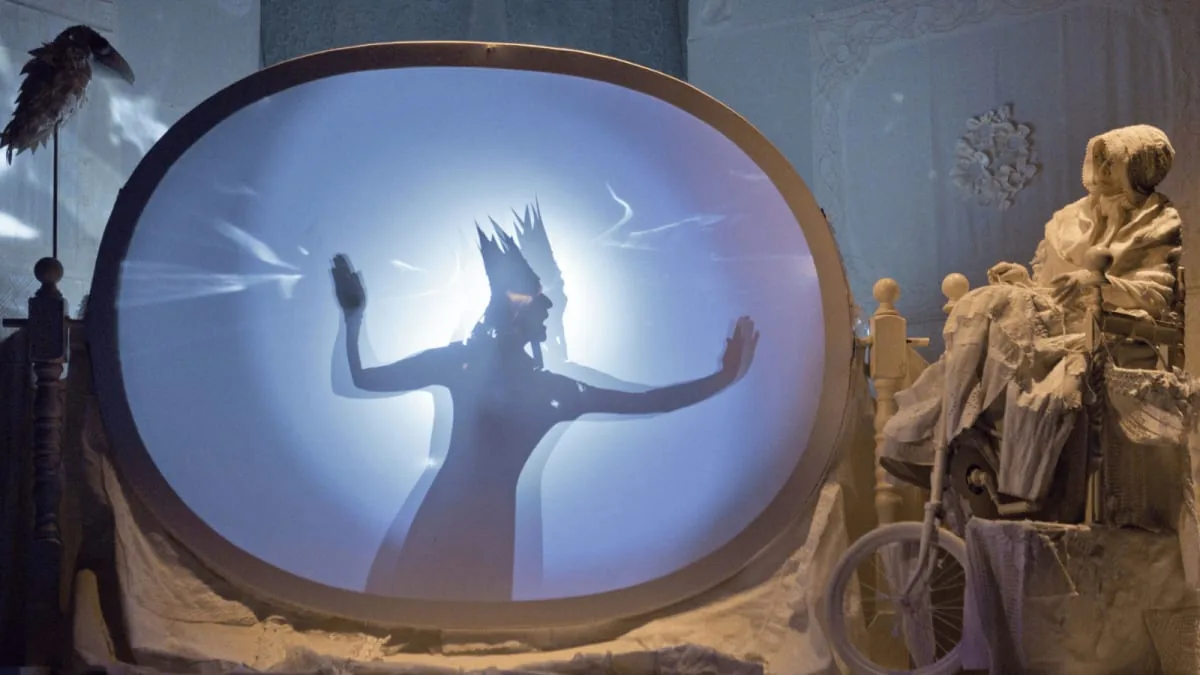
THE SNOW QUEEN || A Shadow-Theatre Fairy Tale for Children
theaterAbout
Hans Christian Andersen's fairy tale The Snow Queen is one of the Danish storyteller's best-known works and has become a worldwide classic of children's literature. The story of a girl named Gerda who journeys in search of her brother Kay has been staged in various theatres and adapted for the cinema many times. Although H. C. Andersen's The Snow Queen was staged at Vilnius's Lėlė Theatre in 1993, with Vitalijus Mazūras as director and designer, the production team's original ideas have inspired a return to the work.
According to the production's director, Nijolė Indriūnaitė, Andersen's fairy tale contains questions relevant to every generation of young audiences: what forms the foundation of our relationships with one another; how should we understand the meeting of Life and Death; and where can we find the hope so essential to creating a new quality of communication? In the story of the fairy tale's main characters, sister Gerda and brother Kay, these questions arise when the children lose the ability to listen sincerely to one another and cease to be attentive to a loved one's doubts and pain. Gerda's journey to Lapland, the Snow Queen's land, to find her brother there and bring him home is, in Nijolė Indriūnaitė's words, a journey of “nurturing faith and love in a child's inner world”.
“In the word ‘tikėjimas’ [Lithuanian for ‘faith’], we see an encoded reference to a specific action that can restore peace of mind: ‘tik - ėjimas’ [‘only walking’], the action that propels Gerda forward and keeps her from losing hope,” reflects N. Indriūnaitė. She emphasises that the production gives considerable creative scope to the expressive forms of shadow and visual theatre, allowing it to develop an associative, multifaceted range of meanings.
The actors perform using the principles of shadow theatre, with screens of various sizes, projections, puppets of different forms and construction techniques (paper cut-outs and carved, textured shadows), masks and sculptural paper objects. The stage imagery is created using principles characteristic of cinematic aesthetics: the montage of different shot scales and images, and the expressive dynamics of objects in motion. “We want young audiences to immerse themselves in a distinctive visual world, filled with images of dreams and visions, unfolding like a memory,” says the production's designer, Aušra Bagočiūnaitė Paukštienė.
Details
Date
December 30, 2026
Location
Vilniaus teatras „Lėlė“
Price
nuo 3.62 €