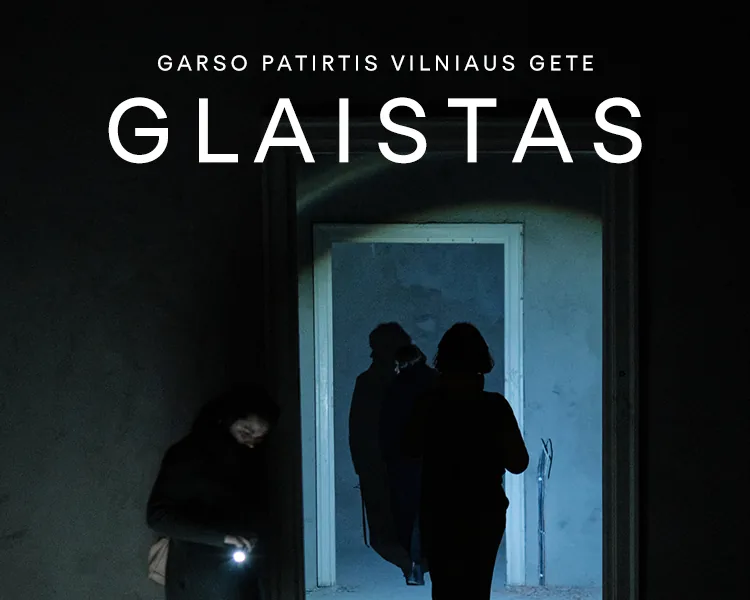
Sound Experience in the Vilnius Ghetto “Glaistas”
“Glaistas” is a sound journey through the former Vilnius Ghetto and the fractured recesses of Holocaust memory. The journey's sound map is composed of musical fragments created specifically for each space, and its direction is charted by the voices of four Holocaust survivors who moved from their native Vilna to Israel after the war, recorded by the creators of “Glaistas” in conversations in Tel Aviv, Jerusalem, and Haifa in May 2019. Frida Sohat (b. 1929) was imprisoned in the Vilnius Ghetto and the Klooga (Estonia) and Stutthof (Poland) concentration camps. She moved to Israel in 1957 to reunite with her father, who had survived the war. Joshua Zak (1929–2024) left Vilnius and settled in Haifa, becoming a professor of physics at the Technion – Israel Institute of Technology. In 1989 he discovered the Zak phase (Z(k)), for which he was awarded the prestigious Wigner Medal in 2014. Sore Voloshin (1928–2020) was the sole survivor of a family of more than 50 people in Vilnius. She was the cousin of Yitskhok Rudashevski, the young diarist of the Vilnius Ghetto who was murdered in Paneriai. Baruch Shub (1924–2020) took part in the Jewish underground resistance movement during the war. After moving to Israel, he became a flight engineer. Until the end of his life he lectured on antisemitism and was a member of various public organizations. The sound document, as an artifact of memory, is the central axis of the work, around which unfold musical interpretations of the streets, courtyards, corridors, apartments, halls, and other spaces of the former Vilnius Ghetto. Within them, the interview fragments lose their purely narrative function – the sonic events captured in the recordings offer themes for choirs or electronic compositions, individual accounts take on the character of arias, and voices weave into the soundscapes to become full-fledged means of musical expression. All of this is complemented by extensive use of binaural recordings, which give the sounds heard through headphones a sense of reality. This gives rise to the distinctive musical narrative aesthetic of “Glaistas”, a dynamic Gesamtkunstwerk for today, in which the viewer's own body and its movement through space also become important. The work balances between shifting “into those times” and returning “to today”. While exploring the limits of such a shift, first of all within their own minds, the creative team does not hide the fact that the walk takes place through today's Vilnius – a city rapidly changing, being painted and renovated, wrapped in construction netting, and in places still awaiting a fresh coat of putty (glaistas). The creators, who accompany viewers in small groups, invite them to look together at what lies beneath the putty and to reflect on important questions: are there limits to how the Holocaust can be understood? Where does memory end and imagination begin (if such a boundary is even possible)? In what forms does (or could) that which was almost entirely destroyed during the war return? In 2020, the creative team behind the Vilnius Ghetto sound walk “Glaistas” was awarded the Golden Stage Cross for best dramaturgy. Authors: playwright Rimantas Ribačiauskas, director Mantas Jančiauskas, composers Jūra Elena Šedytė and Andrius Šiurys The work uses audio recordings from interviews with Frida Sohat, Joshua Zak, Sore Voloshin, and Baruch Shub Duration: 80 minutes The work is in Lithuanian, English, Russian, Hebrew, and Yiddish, with Lithuanian / English / Russian / Hebrew subtitles Time: 4 shows daily: from 18:00, 18:30, 19:30, and 20:00 Tickets can be purchased here.
Adresas: Žydų kultūros ir informacijos centras