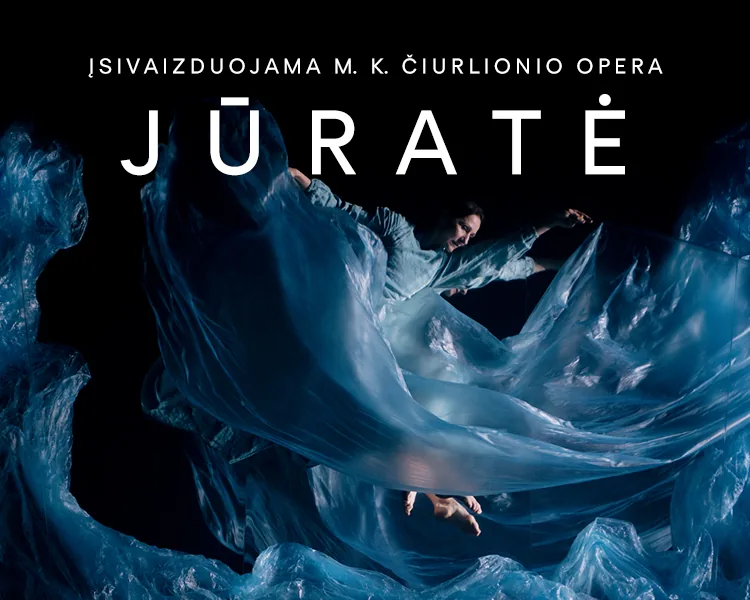
The Imagined M. K. Čiurlionis Opera “Jūratė”
Mikalojus Konstantinas Čiurlionis (1875–1911) understood very well the weight and importance of the opera genre within the whole field of culture. In January 1906, he wrote to his brother Povilas (even before the first national opera – Mikas Petrauskas's “Birutė”): “Are you aware of the Lithuanian movement? I am determined to devote all my past and future works to Lithuania. We are learning the Lithuanian language, and I am preparing to write a Lithuanian opera.” In this way, the composer singled out opera as a particularly significant form of expression for national musical culture identity. The idea of creating a Lithuanian opera became a concrete aspiration for M. K. Čiurlionis after he met a young writer, later his wife, Sofija Kymantaitė. By the summer of 1908, the subject of the opera was already known. The opera was to be based on the legend “The Queen of the Baltic Sea”, created around 1830 by Liudvikas Adomas Jucevičius, a figure of Lithuanian letters, ethnographer, folklorist, writer, historian, and translator. Surviving sketches of M. K. Čiurlionis's stage designs, as well as correspondence about the libretto Sofija was preparing, clearly show that they drew on this version of the legend of the love between Jūratė and Kastytis. From the correspondence we know that Sofija had finished the libretto and sent it to Saint Petersburg, where Konstantinas was staying at the time. We also know that there the composer spent considerable time at the piano with the libretto, searching for the sound of “Jūratė”. About the musical language and stage intentions of the future opera, Konstantinas, having already read the libretto, wrote to Sofija: “'Jūratė' pleases me more each time, and today I already heard a little of the music in it. Zose, Zose, advise me. Should I avoid folk melodies in it, or not? Should I take technical difficulties into account, or not? Because when I think how poor our people are and have nothing, I feel sorry that this work, too, will pass them by, and yet you and I want to give them something. You understand me, Zosele, that I don't want to betray myself, I only want to set myself a harder task. I want it to be possible to perform even in Warsaw, and, when the time comes, in Vilnius too, but much water will flow before then.” From the letters it becomes clear that the composer already had a clear and detailed vision of the opening and first scene of the opera – the order in which characters would appear, the layout of the operatic numbers, the sequence of entries of the choral voices, and similar details – yet all of this remained unwritten or unpreserved in musical notation. In 1906–1909, when the composer was considering the possibility of creating the opera, Čiurlionis's works from that period, preserved mostly in the form of sketches, reveal a highly varied and subtle artistic world dominated by marine imagery and interwoven fragments of folk songs, testifying to compositional strategies that were very bold for their time. These sketches and fragments reveal how deeply Čiurlionis had immersed himself in the planned Lithuanian opera “Jūratė”. Building on these sketches and fragments, on the ideas preserved in the Čiurlionis couple's letters, on the stage design sketches, and also using artificial intelligence (AI) tools to generate musical material, a large creative team has created the imagined M. K. Čiurlionis opera “Jūratė” – a dream that Konstantinas himself never managed to fulfill. The opera tells the legend of the sea goddess Jūratė, whose amber palace stands on the bottom of the Baltic Sea. Jūratė falls in love with a man of the earth – the brave and simple fisherman Kastytis, who defies the will of the gods and fishes in the sacred waters of the sea forbidden to humans. The gods, especially the mighty Perkūnas (Thunder), are enraged by the forbidden love between the divine queen and a mortal man. He strikes Jūratė's amber palace with lightning, shattering it and separating the lovers. Kastytis drowns in the raging sea, and Jūratė is condemned to weep forever for her lost love and to wash amber tears onto the shores of the Baltic. However, Čiurlionis wanted his opera to remain open to interpretation and perhaps to bear witness to eternal love, so, as he had envisioned, the finale of the imagined “Jūratė” features an “Eternal Duet”. The imagined M. K. Čiurlionis opera “Jūratė” was created for the stage of the Vilnius Old Theatre and for its compact orchestra pit. This space was not chosen by chance. After all, it is precisely the Vilnius Old Theatre, built in the early 20th century and opened in 1913, that could have become the stage on which the long-dreamed-of fruit of Sofija and Kastukas's shared creative work would have sounded. Historical consultant Rokas Zubovas Libretto author Julius Keleras Composers: Mantautas Krukauskas, Arvydas Malcys, Mykolas Natalevičius Director and puppet designer Gintarė Radvilavičiūtė Choreographer Sigita Mikalauskaitė Set and costume designe
Adresas: Vilniaus senasis teatras