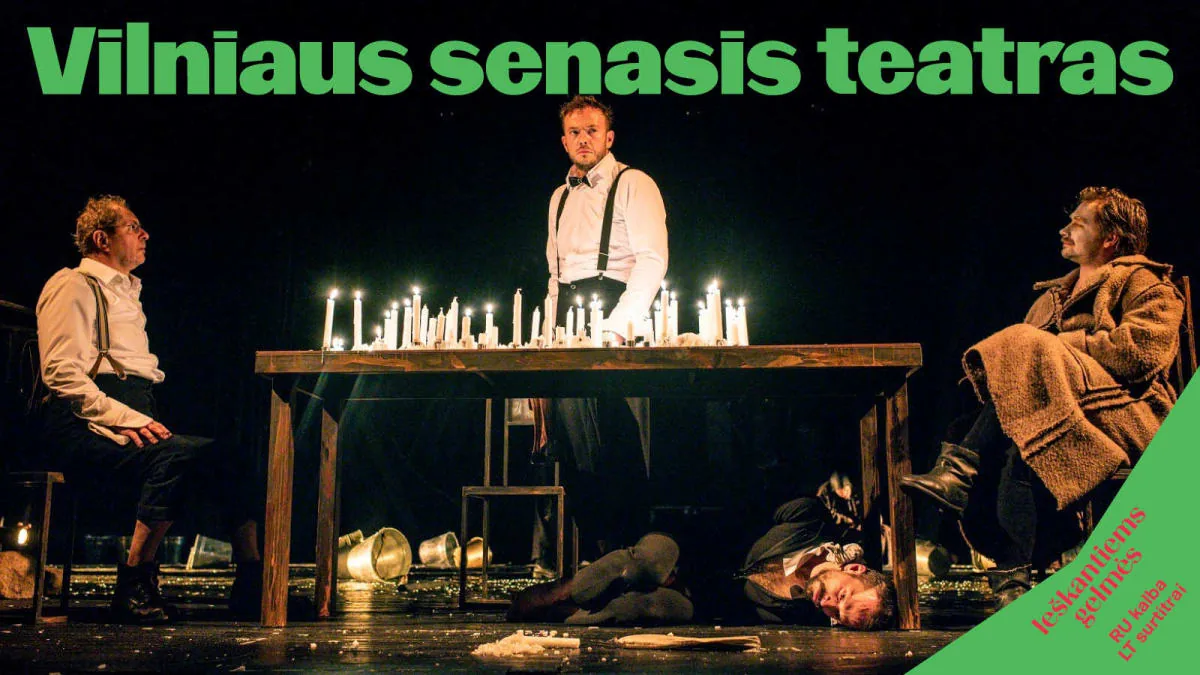
Tom Stoppard: ROSENCRANTZ AND GUILDENSTERN ARE DEAD (Dir. Yuri Butusov)
theaterAbout
Premiere: September 16, 17, 19, 2023.
The performance is in Russian with Lithuanian subtitles.
Age 14+
Rosencrantz and Guildenstern Are Dead, a play by Tom Stoppard, one of contemporary theatre's most important playwrights and an advocate of the theatre of the absurd, was first performed in April 1967 at The Old Vic theatre in London. At the time, Stoppard was a little-known emerging playwright and theatre critic. Through the playwright's will, two unassuming characters from William Shakespeare's play Hamlet, Rosencrantz and Guildenstern, or people who failed to say “no” in time, became heroes of contemporary drama and of our times.
The familiar classical plot of Shakespeare's play is ingeniously played upon: King Claudius, the murderer of Hamlet's father, summons Rosencrantz and Guildenstern, friends of the Danish prince Hamlet from childhood and from his studies at a German university, to accompany the prince to England. The king hands them a secret letter requesting that the rightful heir to the crown be beheaded. Rosencrantz and Guildenstern escort Hamlet towards certain death, but when the prince successfully switches the letter, they themselves become caught in the snares of fate.
Scholars of contemporary drama stress that Rosencrantz and Guildenstern Are Dead wittily fuses classical Shakespearean dramaturgy with Beckettian literary experiments and the aesthetics of the absurd, and intellectual puzzles and virtuoso wordplay with English irony. The playwright tells Hamlet's story from the perspective of two minor characters in Shakespeare's play, Rosencrantz and Guildenstern, whom he turns into the protagonists. This creates the effect of a video camera having been left running somewhere backstage during the making of Hamlet: fragments of Shakespeare's texts can be heard in the background, Ophelia, Polonius and Hamlet himself appear and disappear, while Stoppard's characters try to understand their true role in this confusion, in Shakespearean time.
Director Yuri Butusov says that he particularly values the poetry of this play, now regarded as a classic, and the possibilities offered by the classic style of the absurd. Rosencrantz and Guildenstern Are Dead speaks very precisely to today's context and its painful issues, and should remind audiences of a lost paradise and the impossibility of human fulfilment, harmony and happiness. In Butusov's production, the illusion of theatre within theatre will also be revealed and reinforced by the production designer Marius Nekrošius's pared-down set design and costumes, distinguished by unexpected materials and textures. This is the first time the play is being staged in Lithuanian theatre.
Tom Stoppard (born 1937) is an English playwright and screenwriter. From 1954 he worked as a correspondent for Bristol newspapers; in 1960 he took a job in radio in London, began writing radio and television plays, and wrote theatre and film criticism for periodicals. In the 1970s he became involved in the struggle for human rights, visiting the USSR and Czechoslovakia. The author continues the traditions of absurdist drama and of the artistic expression of Sławomir Mrożek and Václav Havel. His work is characterised by paradoxical situations, experimentation, an analytical approach and unusual juxtapositions: academic philosophy is likened to gymnastics competitions. Written in 1964–1965, Rosencrantz and Guildenstern Are Dead is his best-known work. In 1990, Stoppard himself also directed a film based on it, which has since become a classic.
Yuri Butusov (born 1961) is one of the most prominent figures in the landscape of contemporary theatre. He has won numerous theatre awards and created productions on stages in Russia, Norway, Denmark, Bulgaria and South Korea. Critics call him a shaman-director versed in fantastical or “dream” realism; his productions stand out for their unpredictability, vitality, exceptionally sensitive theatrical language and use of metaphor. His directorial style began to take shape while he was still studying at the Saint Petersburg Theatre Institute.
His very first productions during his studies, Marriage (1995), Notes from Underground (1996) and Waiting for Godot (1996), were already innovative and were received as a radically new voice in the performing arts. It is also possible to identify the authors most important to the director and the directions of his creative work: Shakespeare, Anton Chekhov and Bertold Brecht. He was also one of the first artists to condemn Russia's aggression against Ukraine.
FIRST MESSENGER
What a dreadful scene!
And we have come too late with our business.
The ear that was to hear our news,
That everything was done, that Rosencrantz
And Guildenstern died as instructed,
No longer responds. Who will give thanks?
(W. Shakespeare, Hamlet; Lithuanian translation by Alfonsas Nyka-Niliūnas.)
ROS. And what are these times like?
ACTOR. Indifferent.
ROS. Bad?
ACTOR. Corrupt.
(...)
ROS. What are you playing with here?
GUIL. Words, words. They are all we can still hold on to.
(T. Stoppard, Rosencrantz and Guildenstern Are Dead; Lithuanian translation by Rita Gelombickaitė.)
Details
Date
December 11, 2026
Location
Vilniaus senasis teatras
Price
from 15.10 €