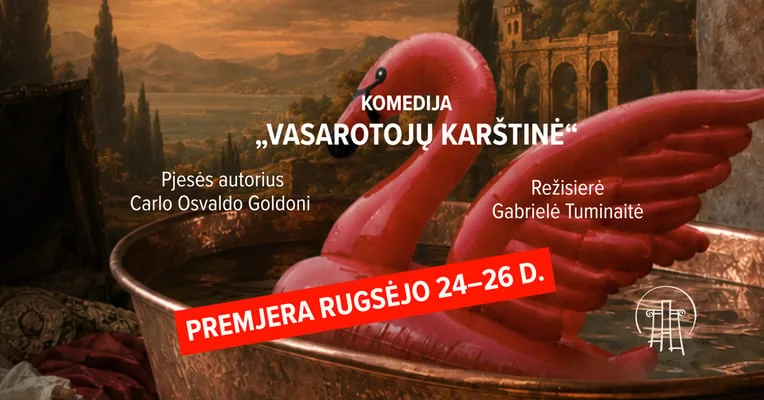
VMT premiere | „VASAROTOJŲ KARŠTINĖ“
theaterAbout
Carlo Oswaldo Goldoni
VASAROTOJŲ KARŠTINĖ
Comedy in two parts
Premiere: 24–26 September 2026
Director – Gabrielė Tuminaitė
“The world is a book from which I have learned the most,” wrote one of the greatest masters of Italian drama, Carlo Goldoni. In his work, this world sparkles and surges with extraordinary force through people, their conversations and everyday situations. By creating simple, true, convincing and easily understood stories, C. Goldoni depicts human relationships from within, unfolding them in all their shades and turning them into a metaphor for the world itself. In the eighteenth century, filled with uncertain prospects for the future and permeated by inexplicable cruelty, when there was a sense that Europe would soon experience a turning point that would permanently change the face of society, C. Goldoni remained profoundly humane, able to deceive people with love and warmth even as he sharply criticised them. His work reached beyond its time: the playwright grasped the condition of modern people and their concerns, and highlighted the importance of a woman’s character when she questioned her deeply rooted traditional role in society. This mastery is most fully revealed in the great „Vasarotojų trilogija“, comprising three works: „Vasarotojų karštinė“, „Vasarotojų nuotykiai“ and „Po vasarojimo grįžus“.
This autumn, director Gabrielė Tuminaitė will present the first part of the trilogy, „Vasarotojų karštinė“, at the Vilnius Small Theatre. Livornas. The characters are feverishly preparing to leave for summer holidays at country villas; at the forefront is Leonardas’s jealousy of his fiancée Džiačinta, who is also being courted by the young Guljelmas. In their desperate haste they disregard both financial and moral norms, consumed by vanity. They hope that once they leave for the villas, that magical “somewhere else”, they will fulfil themselves as people and the problems they are running from will resolve themselves. But it soon becomes clear that the problem lies much deeper—in their complete inability to manage their lives, which are hurtling headlong towards an abyss. As the characters swing continually between anxiety, jealousy, outbursts of anger and irritation, the pace never stops increasing and the momentum rises to madness. As if possessed by this mass evacuation, they leave their own home-theatre littered, ransacked and devastated, and rush elsewhere, to somewhere “better”, hoping to become what they have been promised: more talented, more beautiful and more widely recognised.
Carlo Goldoni (1707–1793) was a Venetian playwright and director who wrote more than one hundred and fifty plays. He took on what then seemed an impossible mission: to create an Italian theatre that would resonate throughout Europe and speak to everyone. Beginning his work at the sunset of commedia dell’arte , he removed the actors’ masks and emphasised the importance of the text, bringing written drama back to the theatre stage. Not properly appreciated in his own time, he left Italy and eventually fell into extreme poverty, regarded merely as the author of mediocre comedies. He experienced a revival in the twentieth century, when leading Italian theatre directors—L. Visconti, G. Strehler, L. Ronconi and others—began staging his works one after another, and sceptical theatre managers had to acknowledge that an artist who had worked two centuries earlier was more relevant than ever. Today C. Goldoni’s work has taken its place among the greatest dramatic works in the world, and Italians recognise the author himself as “the Galileo of new literature”.
The „Vasarotojų trilogija“ is monumental not only for its mathematically refined dramaturgy, but above all for its poetic and mature writing and its almost cinematic precision. A few years ago, the trilogy was included in the list of the world’s 101 greatest and most influential plays, compiled by the respected publisher and editor M. Billington and published by The Guardian.
Over the coming years, the theatre and its partners will present the entire surprising trilogy to audiences, which will be staged as three separate productions.
Creative team
Translated from Italian by – Karilė Mozerytė, Dainius Būrė
Director of the second cast – Karolis Zajauskas
Acting coach – Lucian Roman
Set and costume designer – Youlian Tabakov
Composer – Vygintas Kisevičius
Lighting designer – Audrius Jankauskas
Rehearsal translator – Ieva Frigerio
Assistant directors – Andrius Merkevičius, Simona Ševčenkaitė, Vaidas Jaruševičius
Choirmaster – Tadas Šumskas
Cast
Filipas, an old, cheerful townsman – Mindaugas Capas
Džiačinta, Filipas’s daughter – Alvydė Pikturnaitė / Laura Marija Rinkevičiūtė
Leonardas, Džiačinta’s admirer – Lukas Malinauskas / Mindaugas Činčys
Viktorija, Leonardas’s sister – Greta Bendžė
Ferdinandas, a loafer and idler – Saulius Ambrozaitis
Guljelmas, Džiačinta’s admirer – Mantas Bendžius / Klaudijus Matijošaitis
Fuldžencijus, Filipas’s elderly friend – Almantas Šinkūnas / Arvydas Dapšys
Paolas, Leonardas’s butler – Tomas Stirna / Rokas Siaurusaitis
Bridžida, Džiačinta’s maid – Ieva Gribauskaitė / Radvilė Budrytė
Čekas, Leonardas’s servant – Kyrylo Kremenchuk
Bertas, Leonardas’s servant – Vilius Kalasūnas
Kostanca – Ilona Kvietkutė
Sabina, Džiačinta’s elderly aunt – Jūratė Brogaitė / Rasa Jakučionytė
Tonjinas, a foolish young man in love with Rozina – Kyrylo Kremenchuk
Rozina, Kostanca’s niece – Ieva Gribauskaitė
Summer holidaymakers – Jūratė Brogaitė, Rasa Jakučionytė, Ilona Kvietkutė, Nojus Mikalauskas, Ieva Gribauskaitė, Radvilė Budrytė, Saulė Rašimaitė, Sibilė Zavadskytė, Laura Marija Rinkevičiūtė and others.
Details
Date
September 25, 2026
Location
Valstybinis Vilniaus mažasis teatras, Vilnius