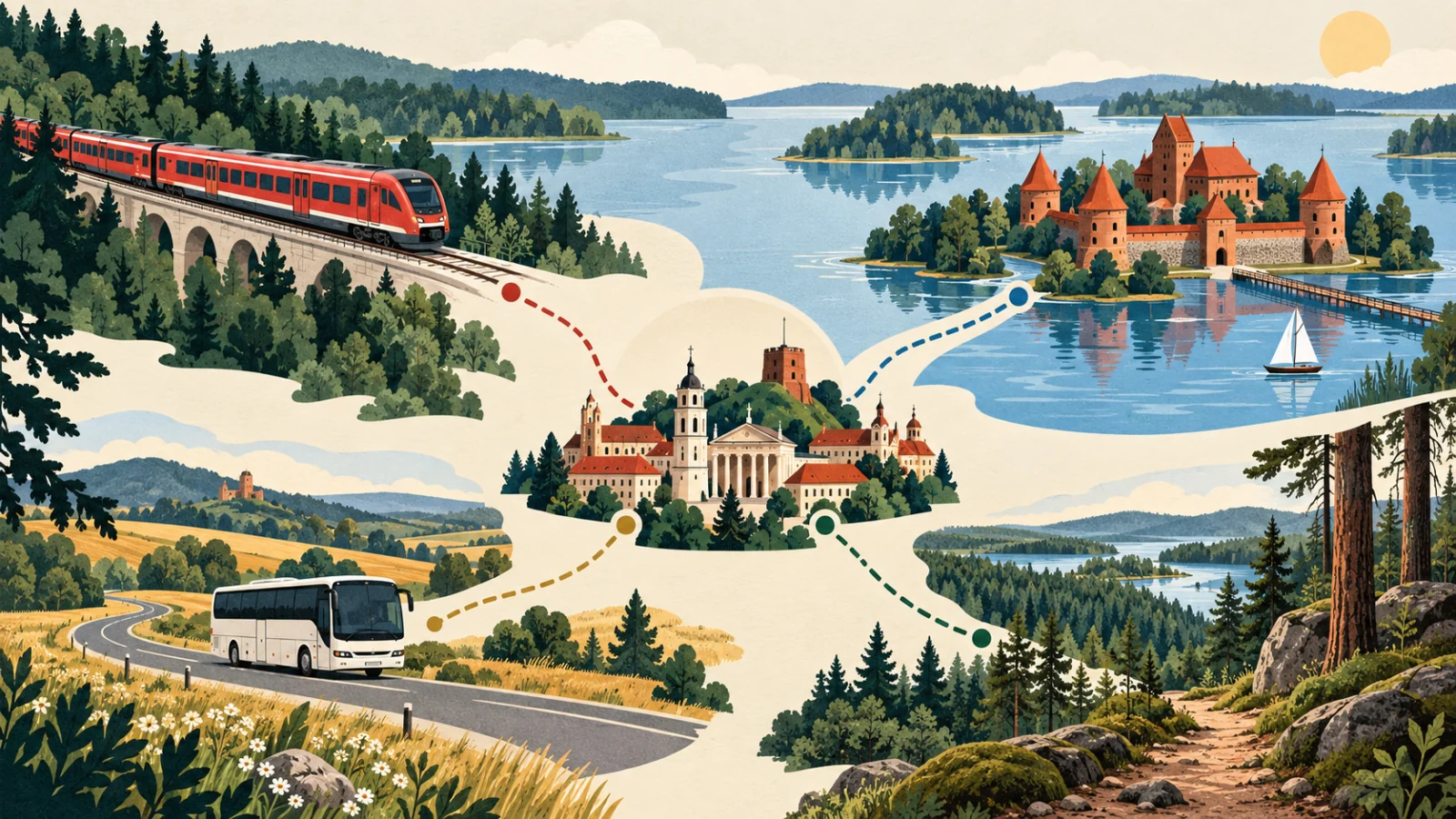
A day trip from Vilnius works best when you choose it by logistics rather than by the length of an attractions list. Trakai is the easiest short escape, Kaunas suits a full urban day, Kernavė rewards travellers interested in archaeology and open landscapes, Europos Parkas fits a half-day outdoors, and Anykščiai is the option that benefits most from a car.
This guide does not freeze one ticket price or a single “last bus” into an evergreen article. Rail works, seasonal services and museum calendars change. Pick the destination first, then search both legs for your exact date and save the latest return that still fits your evening plans in Vilnius.
Choose by time and transport
- Half a day: Trakai or Europos Parkas.
- A full day without a car: Kaunas.
- Archaeology and walking outdoors: Kernavė, after checking the limited bus options.
- A wider nature circuit: Anykščiai, most practical by car.
- A wet-weather choice: Kaunas with one or two central museums.
Trakai for the simplest first trip
Trakai is close enough for a relaxed start and an early return, but the journey does not end at the station. Compare trains and buses on the same date, then allow for the walk to the Island Castle. That final section matters if you are travelling with a pushchair, luggage or limited mobility.
A focused visit needs only the castle, Karaimų Street and time by the lakes. The museum calendar varies by season, so use the Trakai History Museum opening-hours page before leaving Vilnius. Avoid building the day around a forecast fare or a departure time copied from an old article.
Kaunas for an urban day
Kaunas makes sense when you want a second city rather than a quick landmark. The railway station, New Town and Old Town can form one continuous route. Choose one emphasis: modernist architecture, a museum and Laisvės Avenue, or the Old Town and the confluence. Adding distant Pažaislis to the same public-transport day often turns the itinerary into transfers rather than exploration.
Search your date in the official LTG Link journey planner. LTG Link explicitly notes that annual timetables do not include every temporary change, which is why this guide does not promise a fixed duration or fare. For a route built around one museum, confirm that museum’s own calendar as well.
For a detailed route through the city, continue with our Kaunas day-trip guide. The purpose of this overview is to help you decide whether Kaunas is the right destination, not to duplicate every stop from that page.
Kernavė for archaeological landscape
Kernavė combines hillforts, the Neris valley and an archaeological museum. The outdoor archaeological site and the indoor museum are not the same visit: the museum follows opening days, while the reconstructed medieval settlement operates seasonally. Check the current details on the official Kernavė reserve website.
The distance from Vilnius is modest, but public transport is less frequent than to Trakai or Kaunas. Search the outward and return journeys before committing. Carrying the return time offline is useful when you are walking around the hillforts, and a taxi should not be your only unconfirmed backup.
Europos Parkas for art in the forest
Europos Parkas is a useful choice when you want to leave the city centre without devoting the entire day to intercity travel. Treat it as a self-contained outdoor visit. Check the park’s current visitor information, the weather and the return journey before setting out.
Public-transport routings can change, so verify the stop and both directions in the JUDU route planner. Forest paths also make footwear and recent rain relevant. Visitors with mobility requirements should ask the venue about surfaces and accessible sections rather than relying on a general promise.
Anykščiai when the route matters as much as the destination
Anykščiai requires more planning because its attractions are spread beyond the town centre. The Treetop Walking Path is outside town, so a bus to Anykščiai does not by itself solve the final leg. A car makes it realistic to pair the path and Puntukas stone with one additional stop. Trying to combine every museum, hill and activity produces a day dominated by driving.
Use the official regional park page for the Treetop Walking Path to check current hours, rules and access information. Do not plan around a temporary lift notice remembered from a previous season.
A five-point check before booking
- Search the exact travel date and select the return before the outbound journey.
- Confirm the main venue’s opening day on its own website.
- Measure the walk or local connection from the station to the attraction.
- Keep one weather or closure alternative, not a second full itinerary.
- Leave enough margin to miss one connection without losing your evening in Vilnius.
For the lowest-friction first trip, choose Trakai. Pick Kaunas for museums and a full city route, Kernavė for archaeology, Europos Parkas for a shorter outdoor reset, and Anykščiai when you have a car and want to build a broader nature circuit.
## Frequently Asked Questions **Q: Is Vilnius safe for tourists, particularly for solo travelers?** A: Vilnius is generally considered very safe for tourists, including solo travelers, with low crime rates. While serious crime is rare, it's always wise to exercise standard precautions, especially in crowded areas or when out late at night. **Q: How expensive is a typical trip to Vilnius for a few days?** A: Vilnius offers good value compared to many Western European capitals, making it an affordable destination. A mid-range budget might see you spending around €60-€100 per person per day for food, local transport, and entrance fees, excluding accommodation. **Q: What's the best time of year to visit Vilnius for pleasant weather?** A: The most pleasant times to visit Vilnius are late spring (May-June) and early autumn (September), when temperatures typically range from 15°C to 22°C. These months offer comfortable conditions for exploring the city and its surroundings before the summer heat or winter chill. **Q: What local dishes are a must-try when visiting Vilnius?** A: You should definitely try "cepelinai" (large potato dumplings often filled with meat or cottage cheese), "šaltibarščiai" (vibrant cold beet soup, perfect in summer), and "kugelis" (a baked potato pudding). Many traditional restaurants in the Old Town serve these authentic Lithuanian meals. **Q: How easy is it to get around Vilnius without a car?** A: Vilnius is very pedestrian-friendly, especially its historic Old Town, which is best explored on foot. For longer distances, the city has an efficient public transport network of buses and trolleybuses, with single tickets costing approximately €1.00 - €1.50. **Q: Do most people in Vilnius speak English, especially in tourist areas?** A: Yes, English is widely spoken in Vilnius, particularly among younger generations and staff in hotels, restaurants, museums, and shops within tourist areas. While not essential, learning a few basic Lithuanian phrases like "ačiū" (thank you) is always appreciated.