Vilnius Old Town can be walked straight through, from the Gate of Dawn to Cathedral Square, in about half an hour. This would be the most efficient way to miss almost everything for which the 352 ha historic center was inscribed on the UNESCO World Heritage List in 1994. The medieval radial street network is best revealed not on Pilies Street, but by turning into Bokšto, Stiklių, Gaono, and Literatų streets. The route presented below takes 8-9 hours, covers about 5 km, and is suitable for Tuesday, Wednesday, Thursday, or Friday.
9.00 start above the street
The first address is Aušros Vartų g. 14. The Chapel of the Gate of Dawn is accessed by stairs from the left, looking from the Old Town side. It opens at 7.00 and closes at 19.00 all year round Admission is free. Nine in the morning is a practical time: there are not many tour groups on the street yet, but services may be taking place in the chapel. When taking photos, one should not stand in the passage or talk on the phone.
These are the only surviving gates of the city's defensive wall built in the early 16th century. From the chapel, it is worth looking not only at the painting but also through the windows onto Aušros Vartų Street. This immediately reveals an important principle of the Old Town: a sacred space, a defensive structure, and a busy city street occupy the same point here.
After descending, there's no need to rush along Didžioji Street. After passing St. Teresa's Church, turn right onto Šv. Dvasios Street, then go through Subačiaus Street towards Bokšto Street. This detour takes up to 15 minutes and leads to a place where the former city defense is much more clearly visible than at the gates themselves.
10.00 descend to the Bastion
The Bastion of the Vilnius Defensive Wall is at Bokšto g. 20. It is open from Tuesday to Sunday 10.00-18.00, with the last tickets sold half an hour before closing. An adult ticket costs 6 Eur, a concession ticket 3 Eur, and the audio guide is free. The museum is closed on Monday, so this part of the route should be omitted on that day.
Allocate 45-60 minutes for the Bastion. It is cooler underground than outside, so even in summer, a light outer garment comes in handy. From the terrace, the southeastern part of the Old Town, Užupis, and the Vilnia valley are visible. This is a good place to understand the terrain before returning to the dense street network.
From the Bastion, walk along Bokšto Street to Savičiaus Street, then descend along it to Town Hall Square. This section is short, but the pavement is uneven. Flat-soled shoes and high heels are uncomfortable here, especially after rain.
11.30 cross Town Hall Square in a zigzag
The address of Vilnius Town Hall is Didžioji g. 31. The building is not always accessible independently, so on the route, it serves as a landmark rather than a planned museum. From the northern edge of the square, turn onto Stiklių Street, then onto Gaono Street. This 20-minute detour is more useful than walking straight along Didžioji and Pilies streets, as it shows the smaller scale of the block, enclosed courtyards, and narrow cross-connections.
For lunch, it is convenient to return to Dominikonų or Vokiečių Street. On weekdays, lunch offers in the center are often valid from approximately 11.30-15.00, and a realistic budget per person is 12-18 Eur. If you choose not to have a daily lunch special, plan about 15-25 Eur for a main course. On Friday, it is worth reserving a table for 13.00 at least a day in advance. An hour for lunch is enough if you are back on Universiteto Street by 13.15
13.15 dedicate more than one courtyard to the university
The entrance to the central ensemble of Vilnius University is Universiteto g. 3. The courtyards are open from Monday to Saturday 9.00-18.00, and admission is free for individual visitors. In 45 minutes, one can walk through the Library, M. K. Sarbievijus, and Grand Courtyards, and enter St. John's Church. For organized groups accompanied by a guide or a tourism agency, separate registration and fees apply.
In the summer of 2026, it is necessary to observe a temporary scheme here. From July 7, part of the Grand Courtyard is fenced off due to maintenance work, and the bell tower of St. John's Church can only be accessed from the Universiteto Street side, through the Library and M. K. Sarbievijus courtyards. The entrance to St. John's Church shown on older maps may be misleading.
The Bell Tower, Šv. Jono g. 12, is open daily 10.00-19.00, with tickets sold until 18.30 An adult ticket costs 7 Eur, for students, schoolchildren, or seniors 4 Eur. For groups of four or more people, if accompanied by a guide or agency, registration is required. If the weather is clear, ascend now. If the clouds are low or it's raining, it's better to save the 7 Eur for another attraction.
15.00 from the panorama return to street level
From the university, walk along Šv. Jono Street, cross Pilies Street, and turn onto Literatų Street. Its walls feature artists' dedications to writers, so it's worth allocating about 15 minutes for the 100-meter section. Further on, Literatų Street leads to Rusų Street, which, past the Orthodox Cathedral of the Dormition of the Theotokos, descends towards Maironio Street.
At this point, there's no need to try to fit in Užupis as well. Užupis Bridge is very close, but a walk to Konstitucija on Paupio Street and back will add at least an hour. On a one-day route, it's better to stay on the axis of the historic center and leave Užupis for a separate morning.
Until 16.30, dedicate the remaining time to Bernardine Church and garden. This way, you won't have to wait at the closed doors of St. Anne's, and a half-hour break in the park will substitute for another cafe stop.
16.30 plan Gothic according to the doors, not the photo
The address of St. Anne's Church is Maironio g. 8, and the adjacent Bernardine Church is Maironio g. 10. From Tuesday to Friday, St. Anne's Church is open to visitors only 16.30-19.00, on Saturday 10.30-19.00, and on Sunday 9.00-17.00 Admission is free. Therefore, arriving here during lunchtime on a weekday often results only in a photo of the facade.
The adjacent Bernardine Church is open longer, but during services, the tourist route should be paused. Allocate about 30 minutes for both churches. If you arrive on Monday, do not plan to enter St. Anne's, view the facade, and continue towards the Bernardine Garden, Barboros Radvilaitės g. 8A.
18.00 choose one finish
The shorter option ends at Cathedral Square. From St. Anne's Church to it is about a 10-minute walk through the Bernardine Garden and Šventaragio Street. Here you can compare two completely different layers of the city: the Neoclassical Cathedral and Castle Hill rising behind it.
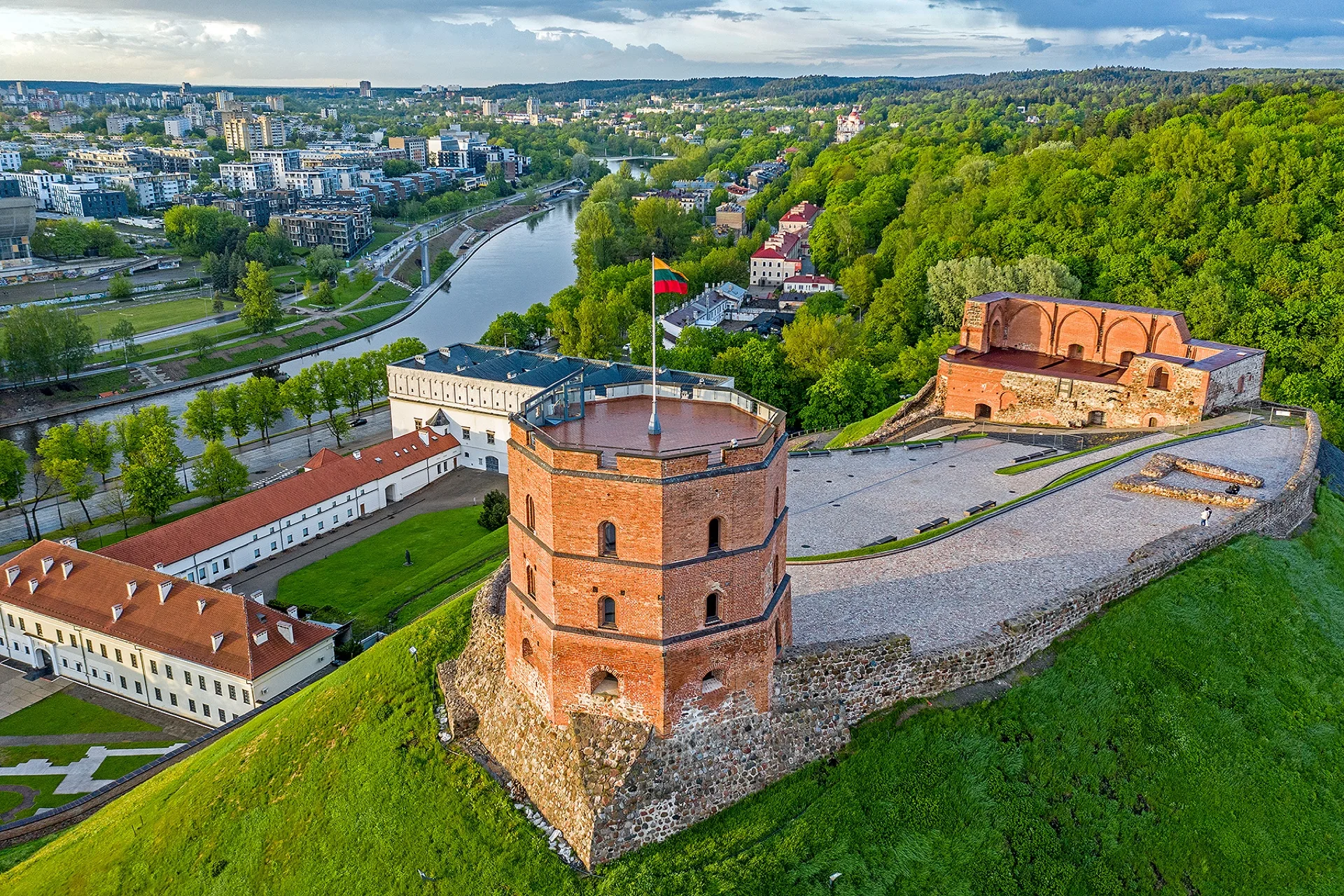
For a longer finish, choose Gediminas Castle Tower, Arsenalo g. 5. It is open daily 10.00-20.00, an adult ticket costs 8 Eur, a concession ticket 4 Eur, with the last tickets sold at 19.30 The funicular from the Old Arsenal courtyard costs 2 Eur one way or 3 Eur round trip. The path from the Vilnia side is free, but not suitable for bicycles, wheelchairs, or strollers. The tower itself is also not adapted for visitors with mobility impairments.
With the Bastion and St. John's Bell Tower, the total for paid attractions for one adult is 13 Eur. Adding Gediminas Tower and the funicular round trip, it increases to 24 Eur. If you only have half a day, omit the Bastion and Gediminas Tower, start at 12.00 in Town Hall Square, visit the university, Literatų Street, St. Anne's complex, and finish at Cathedral Square. This leaves four hours, and the Old Town does not become a race between ticket offices.
Frequently Asked Questions
Q: Is Vilnius a safe city for tourists? A: Vilnius is generally a very safe city for tourists, with low rates of violent crime. Visitors should exercise standard precautions like being aware of pickpocketing in crowded areas, especially during peak tourist seasons.
Q: What is the average daily budget for a visitor in Vilnius? A: A mid-range daily budget for a visitor in Vilnius can range from €60-€100, covering meals, public transport, and entrance fees. Budget travelers might manage on €30-€50, while luxury experiences can exceed €150 daily.
Q: How do you get from Vilnius Airport (VNO) to the Old Town? A: The easiest way to get from Vilnius Airport (VNO) to the Old Town is by train or local bus. The train takes up to 8 minutes to the main station and costs €0.90, while taxis and ride-sharing services are approximately €10-€15.
Q: When is the best time to visit Vilnius, Lithuania? A: The best time to visit Vilnius is typically from May to September when the weather is mild and pleasant, with average temperatures between 15°C and 25°C. December also offers a charming experience with festive Christmas markets, despite colder temperatures.
Q: What traditional Lithuanian dishes should I try in Vilnius? A: You should definitely try cepelinai, large potato dumplings often filled with meat or cheese, and šaltibarščiai, a refreshing cold beet soup perfect for summer. Also look for kugelis (potato pudding) and various dark rye bread preparations.
Q: What language do they speak in Vilnius, and is English widely understood? A: The official language spoken in Vilnius is Lithuanian. While Lithuanian is the primary language, English is widely understood and spoken, especially among younger generations and in tourist-oriented businesses, hotels, and restaurants.
## Frequently Asked Questions **Q: Is Vilnius a safe city for tourists?** A: Yes, Vilnius is generally very safe for tourists, including solo travelers, with low crime rates. Standard precautions like watching your belongings in crowded areas are advisable, particularly at night. **Q: How much does a typical meal cost in Vilnius?** A: A casual meal in a mid-range restaurant in Vilnius typically costs €10-€20 per person, while street food or bakery items can be found for €3-€7. For a budget traveler, daily food expenses might range from €20-€40. **Q: What is the best way to get from Vilnius Airport to the city center?** A: The train is the fastest way, reaching Vilnius Railway Station in about 7 minutes for €0.70-€1. Public buses (like routes 1 or 88) also connect the airport to the city center in 15-20 minutes for €1-€1.50. **Q: What is the best time of year to visit Vilnius?** A: The ideal time to visit Vilnius is during late spring (May-June) or early autumn (September), when the weather is mild and pleasant, averaging 15-20°C (59-68°F), and tourist crowds are moderate. Summer (July-August) is also popular but can be warmer and busier. **Q: What traditional Lithuanian dishes should I try in Vilnius?** A: Must-try dishes include "Cepelinai" (potato dumplings filled with meat or curd), "Šaltibarščiai" (cold beet soup), and "Kugelis" (potato pudding). Many traditional restaurants in the Old Town offer these authentic flavors. **Q: What is Vilnius most famous for culturally?** A: Vilnius is renowned for its UNESCO-listed Baroque Old Town, diverse architectural styles, and vibrant arts scene. It is often celebrated for its unique blend of Eastern and Western European influences.