Vilnius is still called the Jerusalem of Lithuania (Yiddish: Yerushalayim de Lita), because until World War II, it hosted one of the strongest Jewish communities of scholarship and spiritual life in Europe. At the beginning of the 20th century, Jews constituted up to 40% of the city's population; about a hundred synagogues and prayer houses operated in the city, the global Yiddish language research institute YIVO was founded in 1925, and the name of the Vilna Gaon was known to every Jew in Eastern Europe. Before the start of the Holocaust in 1941, between 60,000 and 80,000 Jews lived in Vilnius. Fewer than 500 of them survived the war.
This guide compiles precise addresses, 2026 opening hours, and prices for the most important Jewish heritage sites in Vilnius, from the streets of the former quarter to the Paneriai Memorial. Some facts changed just a year ago, especially at the Great Synagogue site, so older sources may provide inaccurate information.
Former Jewish Quarter: Žydų, Stiklių, and Gaono streets
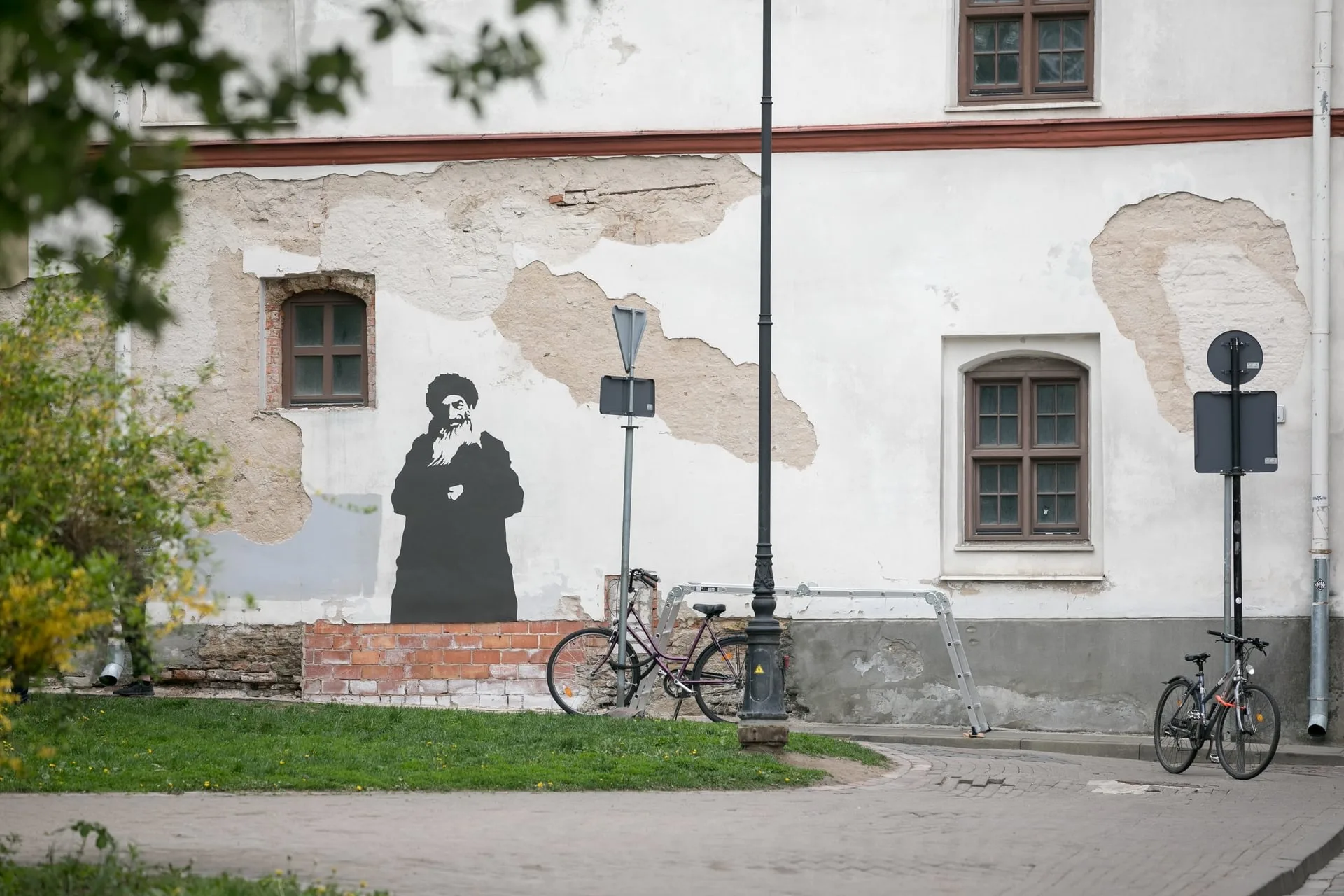
The quarter between Žydų, Stiklių, Mėsinių, and Gaono streets was one of the most densely populated parts of the Old Town until 1941: narrow streets, artisan workshops, and dozens of small prayer houses (shtibls) side by side. The building facades have been preserved, so the most valuable aspect here is not one specific object, but rather the unhurried walk itself, looking into the old courtyard entrances between Žydų and Vokiečių streets.
In the courtyard of Žydų g. 5 stands a bronze bust of the Vilna Gaon. The monument was unveiled on September 12, 1997, commemorating the 200th anniversary of the scholar's death, precisely at the location where the house stood in which the Vilna Gaon Eliyahu ben Shlomo Zalman, born in 1720, lived until his death in 1797. Sculptor Mindaugas Šnipas recreated the work in an extremely short time based on a plaster model created by Teodoras Kazimieras Valaitis in 1959. The remains of the Vilna Gaon were reburied three times: from the Šnipiškės cemetery to the Užupis Jewish cemetery in 1950, and after its destruction in 1968, to the current mausoleum in the New Vilnius Jewish Cemetery near Sudervės road, which remains a place of pilgrimage today. The year 2020 was declared the Year of the Vilna Gaon by the Seimas, commemorating the 300th anniversary of his birth.
On the outskirts of the former ghetto territory, in the so-called Ghetto Victims' Square (Dysnos g. 2A), stands another monument: to physician Tsemakh Shabad (1864-1935), who treated poor city children for free. Writer Korney Chukovsky, who knew Shabad personally, was inspired by him to create the character of the good doctor Aibolit, known as the Russian retelling of Hugh Lofting's Doctor Dolittle. The bronze sculpture, unveiled in 2007, depicts Shabad talking to a girl holding a cat in her arms.
Great Synagogue Site: from ruins to memorial square
On the same plot at Žydų g. 5, the Great Synagogue of Vilna was completed in 1633: a Renaissance and Baroque style building whose main hall accommodated 300 people, and during major holidays, including the surrounding prayer houses, could hold up to 5000 people. The synagogue was surrounded by a shulhoif, a complex of trade, craft, and educational buildings, which also housed the library founded by Matityahu Strašun in 1892, which grew to 33,000 volumes by 1931.
The Nazi army plundered and damaged the synagogue during World War II, and it was finally demolished by the Soviet authorities from 1955 to 1957. In 1964, a kindergarten was built on the ruins to ensure the site would never be rebuilt. From 2011 to 2021, a team of Lithuanian, Israeli, and US archaeologists conducted excavations here and discovered about 5000 artifacts from the 16th to the 20th century, including the foundation of the bimah (reading platform) found in 2018. In August 2025, the old kindergarten building was demolished, with work completed on September 5, so that the Good Will Foundation could arrange the territory: by mid-2026, it is planned to establish the Great Synagogue of Vilna Memorial Square with a Jewish community center here. If you arrive before the square is completed, tidying up work may still be ongoing at the site.
Excavation findings, as well as paintings of the ruins by artist Rafael Chwoles from 1945 to 1947 and works by contemporary artist Eglė Ridikaitė, are exhibited in the exhibition "Discovering the Great Synagogue of Vilna". The exhibition runs at the Museum of Lithuanian Jewish Culture and Identity from May 19, 2026, to January 31, 2027.
Museum of Lithuanian Jewish Culture and Identity
The newest and largest branch of the Vilna Gaon Jewish History Museum, the Museum of Lithuanian Jewish Culture and Identity, is located at Pylimo g. 4A, in the former building of the "Tarbut" gymnasium, which taught in Hebrew and operated from 1915. The museum opened on January 18, 2024, and occupies three floors with 17 exhibition halls: the first floor tells about shtetl life and Jewish languages, the second about Litvak literature, music, theater, and art, and the third features an exhibition dedicated to artist Rafael Chwoles.
2026 opening hours: Tuesday to Friday from 10 AM to 6 PM, Saturdays and Sundays from 11 AM to 6 PM, closed on Mondays. An adult ticket costs 6 Eur, for schoolchildren, students, and pensioners 3 Eur, a family ticket (2 adults with children) 10 Eur, preschoolers enter for free. Entrance is also free with a Vilnius Pass.
The Green House: Holocaust Exhibition
The wooden house at Pamėnkalnio g. 12 has told the story of the destruction of the Lithuanian Jewish community since the 1990s: from the beginning of the Nazi occupation in 1941 to the extermination of about 95% of Lithuanian Jews. This is one of the highest percentages of Holocaust victims in all of Europe. Personal belongings, photographs, documents, and recorded testimonies are displayed in seven rooms; the exhibition was updated in 2010. Opening hours coincide with the Museum of Lithuanian Jewish Culture and Identity (Tuesday to Friday from 10 AM to 6 PM, weekends from 11 AM to 6 PM, closed on Mondays), and the ticket price is the same as in other museum branches.
Choral Synagogue: the only one remaining out of a hundred
The Choral Synagogue (Taharat Ha Kodesh), located at Pylimo g. 39, was built in 1903 in the Moorish Revival style and is the only one of more than a hundred pre-war Vilnius synagogues that has survived and is still active today. It is an active house of worship for a small but vibrant Jewish community in Vilnius, so visitors are welcome from Monday to Friday, from 10 AM to 3 PM. Visits do not take place on weekends, as services are held. Entrance is free, but it is customary to leave a small donation, about 2 Eur. It is advisable to dress modestly upon arrival; men are offered a kippah at the entrance.
Paneriai Memorial: a journey into silence
About 10 km from the city center, in the Paneriai forest, from 1941 to 1944, German Einsatzkommando units, together with about 80 local collaborators, members of the so-called Special Squad, murdered between 70,000 and 100,000 people. About 70,000 of them were Jews, as well as between 1000 and 2000 Poles and about 8000 Soviet prisoners of war. Six pits were dug at the massacre site, originally intended for Soviet fuel tanks. The most comprehensive testimony about the crimes is the diary of Polish journalist Kazimierz Sakowicz, secretly written while observing the killings from his homestead. The manuscript was found and published in 1999 by Holocaust survivor Rachel Margolis.
The Paneriai Memorial (Agrastų g. 15) is open from Tuesday to Thursday from 9 AM to 5 PM, Fridays from 9 AM to 4 PM, Sundays from 11 AM to 4 PM. Closed on Mondays and Saturdays. Entrance is free. A train runs hourly from Vilnius railway station to Paneriai, the journey takes about 10 minutes, and from the stop to the memorial, you need to walk about 800 to 1000 meters following the signs.
How to plan your visit
The most important practical detail when planning your day: on Monday, both the Museum of Lithuanian Jewish Culture and Identity, the Green House, and the Paneriai Memorial are closed; only the Choral Synagogue is open that day. On Saturday, it's the opposite: the synagogue and Paneriai are closed, only two museum branches are open. To visit all four main sites in one day, choose Tuesday, Wednesday, or Thursday.
The Old Town part, i.e., the former quarter, the Great Synagogue site, the Museum of Lithuanian Jewish Culture and Identity, the Green House, and the Choral Synagogue, are best explored on foot, which will take 3 to 4 hours. Allocate a separate half-day for the Paneriai Memorial, including travel, and check the train schedule in advance, as intervals are less frequent in winter. This is an emotionally challenging but important part of Vilnius's history, so plan a calmer pace and do not combine this visit with a more cheerful day's program.
For those who want to delve deeper into the city's history, it is worth visiting the list of Vilnius attractions, and after a difficult day, the Old Town restaurants are suitable for a quiet lunch or dinner break.