Step off the smooth pavement of Gediminas Avenue onto the cobbles of Pilies Street and Vilnius changes its voice. Within a few blocks, theatre crowds give way to university courtyards, a riverside republic and a wall covered with tiny tributes to writers.
These five streets can be linked in one walk, but each deserves more than a quick photograph. Together they reveal the ceremonial, historic, multicultural, bohemian and literary sides of the city.
Gediminas Avenue: the capital on display
Start at Cathedral Square and face west. Gediminas Avenue runs in a straight line from the historic heart of Vilnius to the Lithuanian Parliament, a little over 1.8 kilometres away. The distance is easy to walk, yet the character of the avenue changes noticeably between its two ends.
Near the cathedral, the street feels formal but never detached from daily life. The Lithuanian National Drama Theatre is immediately recognisable by the Three Muses, the dark sculptural figures above its entrance. A few steps farther, Vincas Kudirka Square provides a convenient pause, while the Money Museum of the Bank of Lithuania offers a focused look at currency, banking and economic history.
The next major stop is Lukiškės Square. On its edge stands the former KGB headquarters, now home to the Museum of Occupations and Freedom Fights. Its prison cells and exhibitions make this one of the city centre's most serious historical sites.
Gediminas Avenue works well at two different times of day. In the morning, it shows how the centre wakes up and moves to work.
Pilies Street: history written in stone and brick
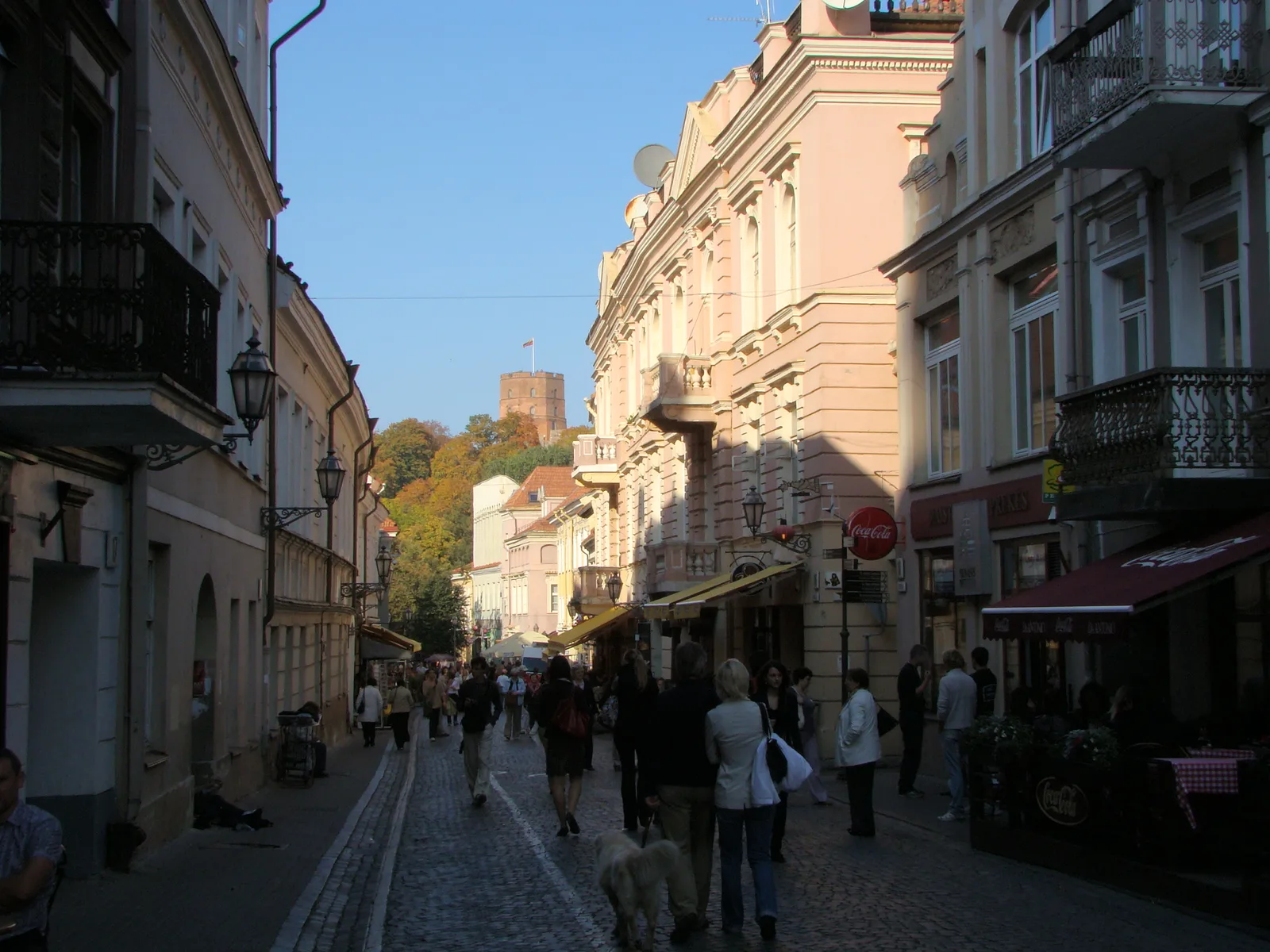
From Cathedral Square, turn into Pilies Street and let the cobbles slow you down. This is one of the oldest streets in Vilnius, recorded in historical sources as early as 1530. It followed the main route to the castle, once used by rulers, papal legates and foreign envoys.
The architecture changes from building to building. The houses at Pilies 12 and 14 preserve Gothic features, Pilies 4 represents the Renaissance layer of the street, and the facade of St John's Church introduces Baroque drama. This compact stretch is a useful reminder that Vilnius Old Town is not defined by a single style.
At Pilies 26, the House of the Signatories marks the place where the Act of Independence of Lithuania was signed on 16 February 1918. From 7 July to 18 November 2026 the museum is temporarily closed while a new exhibition is installed; only its gallery is open. Nearby, the Vilnius University complex opens through arches into a network of courtyards. Entering at least one of them is essential, because the street frontage reveals only a fraction of the university ensemble.
The atmosphere depends on the hour. Early morning brings delivery carts, opening doors and almost empty sightlines.
Vokiečių Street: a broad promenade shaped by absence
Vokiečių Street feels unexpectedly wide after the narrow lanes of the Old Town. The open central space resembles an elongated square, but its width carries a difficult history. Before the Second World War the street was much narrower and densely built.
The name recalls German merchants and craftspeople who settled in this part of medieval Vilnius. In later centuries, the street also became an important boundary and commercial artery of the Jewish quarter. To read that history in the present city, turn into Žydų, Gaono, Stiklių and M. Antokolskio.
A useful place to stop is Vokiečių 6, a branch of the Vilnius City Museum. Its research based exhibitions focus on the city itself, its neighbourhoods, residents and everyday transformations. This makes it especially relevant after walking through a street where so much of the earlier urban fabric is no longer visible.
Vokiečių Street is best used as a pause rather than a corridor. Sit long enough to notice the surviving facades, the openings into side streets and the contrast between the broad public space and the compact Glass Quarter.
Užupio Street: from the river to the Angel
The approach to Užupio Street is part of the experience. Cross the Užupis Bridge from Maironio Street and look down at the Vilnelė River before continuing uphill. A small bronze mermaid sits in a niche beside the water, while the bridge marks the informal border of the neighbourhood that declared the symbolic Republic of Užupis in 1997.
Užupio Street climbs toward the main square, where the bronze Angel of Užupis stands on a tall column. The square is both a landmark and a meeting place. Residents, artists, diners and curious visitors pass through it throughout the day.
Close to the main street, at Paupio 4, the Constitution of Užupis is displayed on mirrored plaques. Its 41 articles combine humour with ideas about dignity, freedom and the right to be oneself. The text has been translated into dozens of languages, so many visitors can find a familiar version and read it in their own words.
Do not end the walk at the Angel. Continue uphill toward Polocko Street, take a side route to the Bernardine Cemetery or return to the river on a smaller lane.
Literatų Street: an open air gallery to be read slowly
Literatų Street can be crossed in minutes, yet it deserves the slowest pace of all five routes. More than two hundred small works dedicated to Lithuanian and international writers, poets and translators cover its walls. Metal, ceramic, glass and wood pieces create a surface that feels less like a monument and more like a notebook assembled by many hands.
The artistic project began in 2008, and the developed literary wall was formally unveiled in 2011. Each object links an artist with a chosen literary figure. Some names are immediately familiar, while others require closer reading.
The name Literatų is connected with the printing houses and bookshops that once operated here, as well as with Adam Mickiewicz. The poet lived near the beginning of the street in the early nineteenth century, a fact marked by memorial plaques. From the far end, it is easy to continue toward St Michael's Church and the Adam Mickiewicz Monument, or to return to Pilies Street and the university quarter.
Visit in the morning to see the textures clearly, or in the evening when individual pieces emerge from the shadows. Pick five works, read their inscriptions and notice how differently each artist interprets literature.
The five streets form a walk of roughly five kilometres. Begin on Gediminas Avenue, cross Cathedral Square into Pilies and Literatų streets, continue over the Vilnelė into Užupis, then return toward Town Hall and Vokiečių Street.
Distance, however, is not the best measure of the route. Leave time for one university courtyard, one museum room, one line of the Užupis Constitution and one long pause without a plan. That is when the streets stop feeling like a checklist and begin to feel like Vilnius.
## Frequently Asked Questions **Q: Is Vilnius a safe city for tourists to visit?** A: Vilnius generally boasts a low crime rate, making it very safe for tourists, even for solo travelers. The Old Town and central areas are well-lit and monitored, though standard precautions against petty theft are always advisable. **Q: How much does a typical trip to Vilnius cost?** A: Vilnius is an affordable European capital; a mid-range traveler can expect daily expenses for accommodation, food, and attractions to range from €50-€80. A main course at a casual restaurant usually costs between €10-€15. **Q: What is the best way to get around Vilnius?** A: The compact Old Town is easily explored on foot, while an efficient network of public buses and trolleys covers wider areas for about €1 per single ticket. Ride-sharing apps like Bolt are also widely available and reasonably priced. **Q: What is the best time of year to visit Vilnius for good weather?** A: The most pleasant weather in Vilnius is typically experienced from May to September, with average temperatures ranging from 15°C to 25°C. July and August offer the warmest days and longest daylight hours, perfect for outdoor activities. **Q: What traditional Lithuanian food should I try in Vilnius?** A: You must try Cepelinai, large potato dumplings filled with meat, and Šaltibarščiai, a vibrant cold beet soup especially popular in summer. Don't miss sampling local dark rye bread and various dairy products. **Q: What major cultural or historical attractions should I prioritize in Vilnius?** A: Prioritize exploring the UNESCO-listed Old Town, including the stunning Vilnius Cathedral and climbing Gediminas' Tower for panoramic city views. The city also features unique cultural sites like the self-proclaimed Republic of Užupis.