When traveling solo, every decision rests solely with one person: when to wake up, how long to spend in a museum, or whether to sit at a bar table alone. Vilnius is practically ideal for this format: the Old Town is concentrated in a small area, most attractions are reachable on foot within 20 minutes, and the majority of service staff speak English. This guide provides specific numbers and locations, not just general reassurances that Vilnius is a friendly and safe city.
Below are three key considerations for solo travelers: is it really safe, where to stay and how to get around without a team to split bills and handle logistics, and what to do if you quickly need company or assistance.
Is it Safe to Travel Solo to Vilnius
According to 2026 Numbeo data, Vilnius's safety index is 71.9, and its crime index is 28.1, which is below the average for most European capitals. In the Global Peace Index, Lithuania ranks 25th out of 163 countries in 2026. Specifically for women's safety, the Women, Peace and Security index is more relevant, where Lithuania is 16th out of 181 countries, as announced by the "Go Vilnius" tourism department in its April 2026 report.
The travel app "Travel Ladies", where women rate cities based on their experiences, gives Vilnius a score of 4.5 out of 5 (16 travel experiences), and the average rating from local women is also 4.5 out of 5 (70 reviews). The only area mentioned by locals themselves in the same source as requiring greater vigilance at night is the area around the bus and train station (Stotis). The biggest real risks in Vilnius are not violent crime, but petty theft in crowded places and occasionally inflated fares from some street taxis, rather than physical safety.
Where to Stay When Traveling Solo
The Old Town remains the most logical base: most museums, cafes, and restaurants are within walking distance, and the streets are well-lit and full of people until late in the evening. A full range of accommodation options can be viewed in the Vilnius accommodation list, and for solo travelers, several specific places are particularly convenient: "Jimmy Jumps House" (Savičiaus g. 12) is located right in the center of the Old Town, while "Pogo Hostel" (Barboros Radvilaitės g. 3) and "Hostelgate" (Aušros Vartų g. 17) are within a 5-minute walk from Cathedral Square.
Dorm bed prices range from approximately 13 to 20 euros per night, depending on the season and specific location, so it's worth checking the exact price on the day of booking. If you prefer a quieter place away from the nightlife, "Downtown Forest Hostel & Camping" (Paupio g. 31A) is located by the river in the Paupys district, and "Filaretai hostel" (Filaretų g. 17) is about a 20-minute walk from the Old Town, but is cheaper and quieter. When choosing between them, it's worth asking yourself one question: when traveling solo, do you want common areas and opportunities to meet other travelers, or would you prefer a quiet room without additional social pressure?
How to Get Around the City Solo
A single ticket for Vilnius public transport costs 1 euro (valid for 30 minutes) or 1.25 euros (valid for 60 minutes), when purchased via the "m.Ticket" app, with a contactless bank card, or from the driver. During the ticket's validity period, you can transfer to another route without an additional charge (source: judu.lt, the official Vilnius public transport operator).
There are three practical options from the airport to the city center, described in more detail in the guide on how to get to the city center from the airport. The train to Vilnius railway station takes about 7 minutes, runs approximately every 30 to 60 minutes from 7:16 to 22:40, a ticket costs about 1 euro, and it's another 10 to 15 minutes walk from the station to the Old Town. Bus 88 (88N at night) circles through the Old Town, stopping near Town Hall Square and Trakų Street, the journey takes 20 to 35 minutes with the same ticket. The third option, "Bolt": a trip to the Old Town costs about 8 to 15 euros and takes 15 to 20 minutes. "Bolt" is the dominant app in the city, "Uber" also operates, but there are significantly fewer drivers, so waiting times are usually longer.
If you plan to visit four or more paid museums in a day, it's worth considering the "Vilnius Pass": the 24-hour version without transport costs 39 euros, with transport 46.50 euros, the 48-hour version (most popular) 49 euros, and the 72-hour version 59 euros (prices according to the official govilnius.lt website). For one or two museums per day, individual tickets usually work out cheaper.
What to See During the Day Without Needing to Coordinate
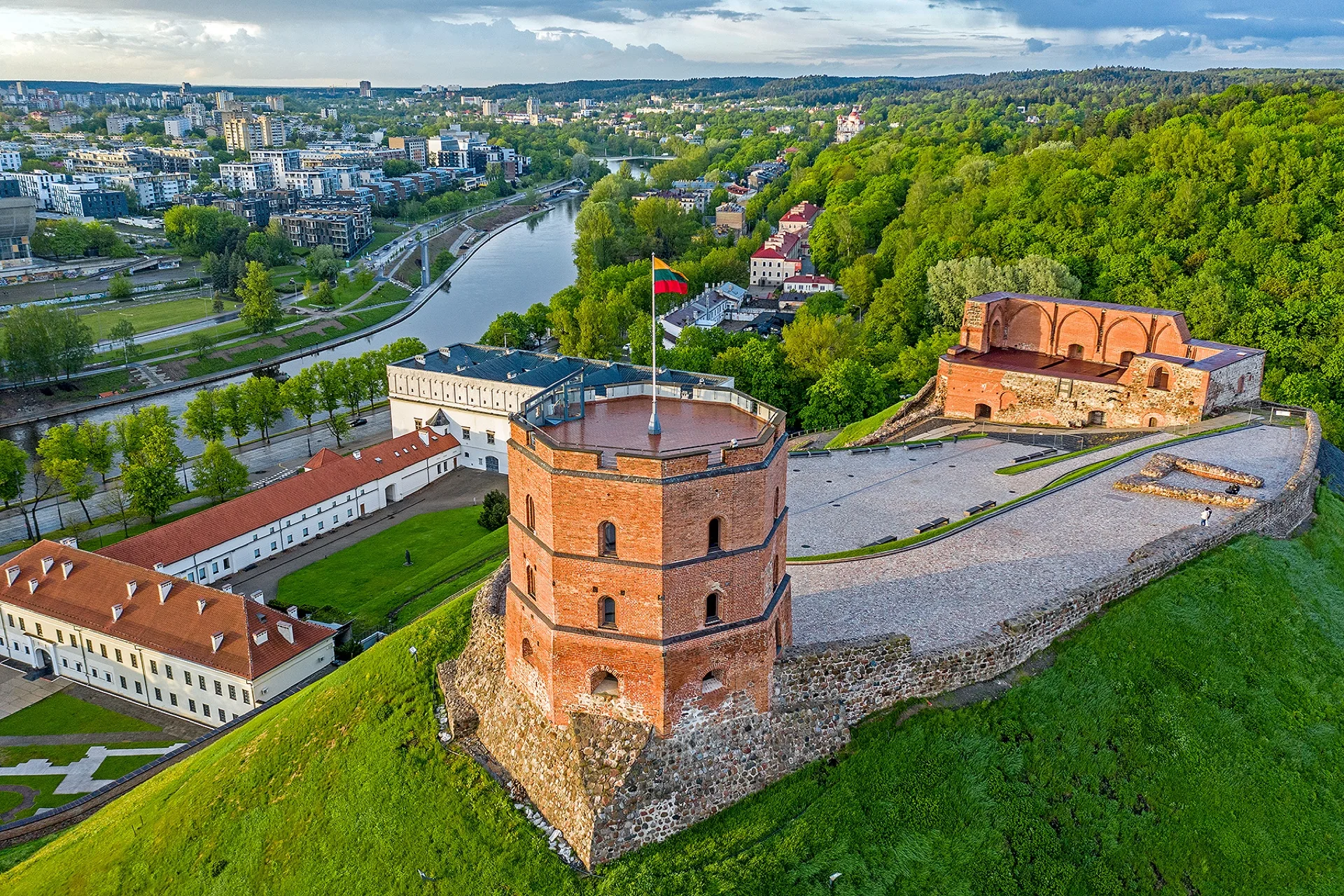
Gediminas Castle Tower (Arsenalo g. 5) is open from Tuesday to Sunday, 10:00 to 18:00, closed on Mondays. You can walk up the hill or take the funicular, which costs about 2 euros one way or 3 euros for a round trip. From the tower, there's a view of the entire Old Town, making it one of the few spots in Vilnius where you can sit quietly alone and observe the city from above. You can find more ideas in the Vilnius attractions list.
Užupis, on the other side of the Vilnia River, is a district that has officially declared itself a republic, with its constitution carved into plaques on Paupio Street. It's pleasant to walk here without a specific route, most streets are safe both day and night.
The Museum of Occupations and Freedom Fights, also known as the KGB Museum (Aukų g. 2A), is closed on Mondays and Tuesdays, open Wednesday to Saturday from 10:00 to 18:00, and Sunday from 10:00 to 17:00. MO Museum (Pylimo g. 17) is also closed on Mondays, open Tuesday to Friday from 12:00 to 21:00, Saturday from 11:00 to 21:00, and Sunday from 11:00 to 19:00. Both museums are convenient for solo visits, as exhibitions can be explored at an individual pace, without the need to coordinate with companions.
A free walking tour (tip-based) departs daily at 10:30 and 15:30 from the Gediminas Monument in Cathedral Square, you'll recognize the guide by a red umbrella or a sign with the organization's logo. The tour lasts 2 to 2.5 hours and is one of the easiest ways to get oriented in the city on your first day, and also to meet other travelers.
Where to Eat and Work Solo
Halės Market (Pylimo g. 58) is open from Tuesday to Saturday, 7:00 to 18:00, Sunday from 7:00 to 15:00, closed on Mondays. Eating alone at communal tables here is completely natural, with options including traditional Lithuanian cuisine, as well as Asian and vegetarian stalls. "Paupys Market" (Aukštaičių g. 7) in the Paupys district operates on a similar principle.
"Caffeine" cafe (Gedimino pr. 2, also a branch at Trakų g. 11) is open weekdays from 7:00 to 22:00, weekends from 8:00 to 22:00, has stable Wi-Fi, and is one of the places where an hour or two spent alone with a book or laptop doesn't feel out of place.
How to Meet People if You Need Company
The "Go Vilnius" tourism department freely administers the "Meet a Local" program (registration at meetalocal.lt): a local volunteer meets with a visiting traveler and shows them the city from their perspective, free of charge. As of April 2026, over 300 travelers have participated in the program. This is one of the rarer, truly effective, free ways to meet a local, not just other tourists.
In the evenings, at beer bars like "Šnekutis" (Šv. Mikalojaus g. 15, open daily 11:00 to 23:00) or "Alaus Biblioteka" (Totorių g. 8), you won't feel awkward arriving alone: both places have communal tables and a regular crowd, so striking up a conversation with a neighbor at the table is the norm, not an exception.
What to Be Aware of in the Evening and at Night
The rules are the same as in any other major European city: when returning late, choose well-lit streets, avoid shortcuts through dark alleys or abandoned courtyards, and keep an eye on your drink in bars. The only area where locals themselves advise greater vigilance at night is around the bus and train station. Instead of street taxis, always opt for the "Bolt" app: before getting into the car, check the driver's name and license plate number in the app to ensure you are getting into the same car specified in your order.
Health, Documents, and Emergency Situations
The general emergency number in Lithuania is 112 (police, ambulance, fire department), and operators answer in English. For EU citizens, the European Health Insurance Card (EHIC) covers treatment in state hospitals, and for UK citizens, the GHIC card does the same. For other travelers, it's advisable to purchase travel insurance before departure, as a visit to a private clinic without insurance can cost tens or even hundreds of euros. A 24-hour pharmacy, "Gintarinė vaistinė", is located at Gedimino pr. 9.
Luggage can be left before or after check-in in coin-operated lockers at Vilnius railway station, the price depends on the locker size and ranges from about 3 to 7 euros per day. Alternatively, you can ask your accommodation's administration to hold your bag until official check-in time or after check-out: most guesthouses and hotels in Vilnius do this free of charge.