VisitVilnius.lt
Vilnius Food Markets: A Guide to Halės, Kalvarijų, Paupio and Tymo — Restaurants | VisitVilnius.lt
Restaurants

Vilnius Food Markets: A Guide to Halės, Kalvarijų, Paupio and Tymo

By VisitVilnius editorial13 min read

A guide to the Vilnius food markets - compare Halės, Kalvarijų, Paupio and Tymo turgus: what to buy, where to eat and the best time to visit each one.

Vilnius markets are one of the best ways to feel the city not through its facades, but through its smells, voices, seasons and genuine everyday movement. A restaurant is a lovely place for dinner and a cafe is perfect for coffee, but a market shows you what the city actually lives on: which vegetables people carry home, what bread they buy for the weekend, where they stop for a quick bite and what the vendor recommends when you ask not formally, but out of real curiosity.

At the market, Vilnius becomes less touristy and more real. Here you can meet a local buying cheese from a familiar seller, a family choosing their weekend lunch, a tourist with a phone in hand looking for something to taste, and a person who simply came for coffee, because the market stopped being only about trade long ago. Food markets in Vilnius today connect several worlds: the old trading tradition, local produce, street food, modern food halls and smaller organic markets.

This guide is for those who want to understand how Halės turgus (Halės Market), Kalvarijų turgus (Kalvarijų Market), Paupio turgus (Paupys Market) and Tymo turgus (Tymas Market) differ from one another. One is historic and conveniently located in the city centre, another is large, local and less polished, the third is a modern food hall format, and the fourth is small, organic and seasonal. If you are planning a gastronomic route, this page is worth pairing with other VisitVilnius.lt guides: Lithuanian food in Vilnius, best restaurants in Vilnius, things to do in Vilnius.

Halės turgus

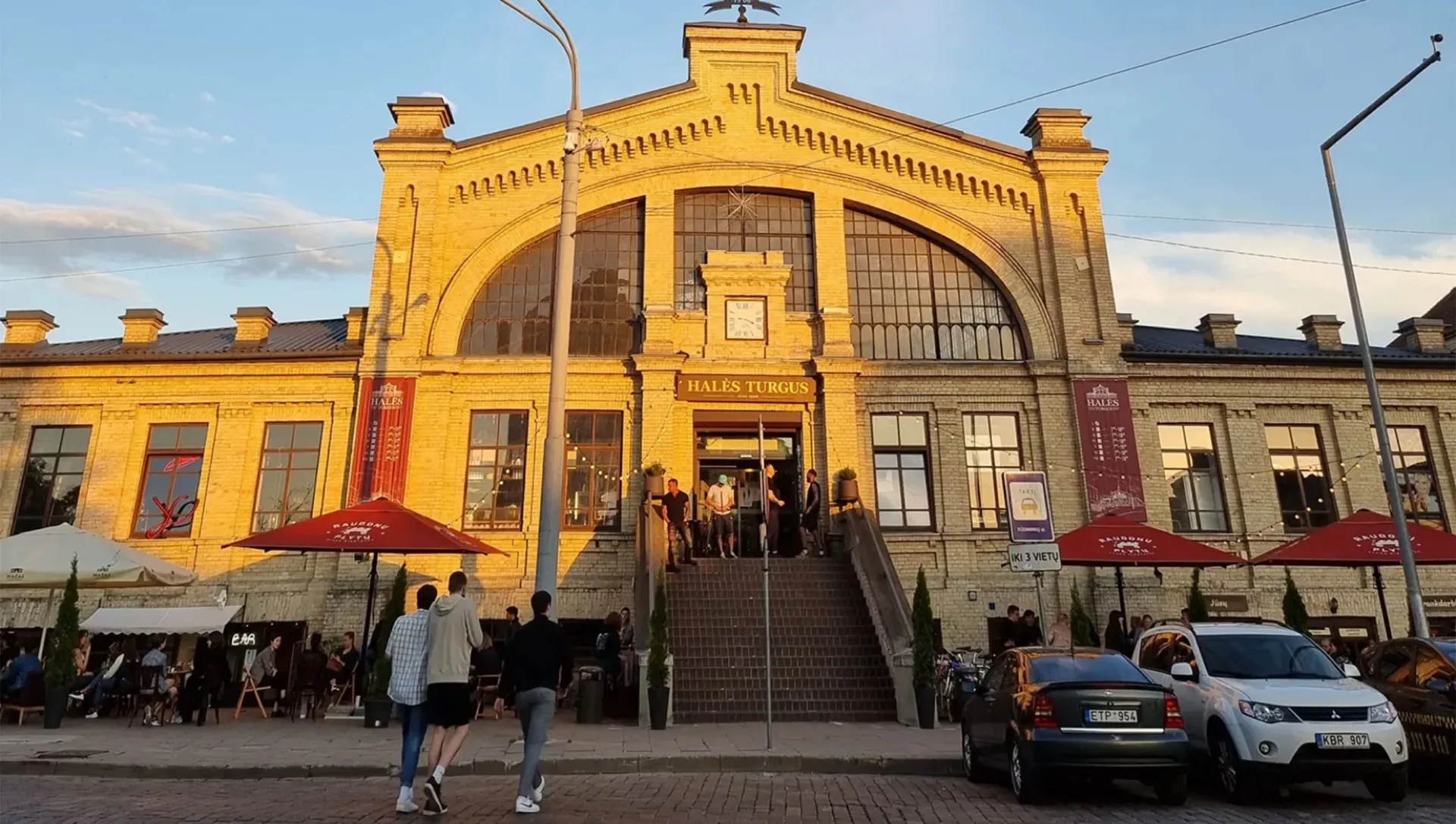
For many, Halės turgus is the first Vilnius market worth visiting. Its advantage is very clear: it is in the centre, in a convenient location near the Old Town routes, so it is easy to drop in even when you only have a few hours in the city. It is a historic market, but not a museum. It is alive, noisy, a little chaotic in the best sense, and full of small everyday scenes.

It is best to visit Halės turgus in the morning or during the first half of the day, when you can still feel the real pulse of the market. Here you can look for fresh produce, bread, cheeses, meat products, baked goods, vegetables, fruit or small local flavours. For a tourist, this is a great place to understand what Vilnius food culture looks like not only as served in restaurants, but also as eaten at home.

Halės turgus is also important today for its eating spots. It is not just a place to shop, but also to stop and eat. Here you can find street-food-style options, and one example is El Barrio, associated with Mexican street food. Such places have changed the function of the market: now you can come not only to buy produce, but also to have lunch, drink coffee, meet a friend or start a walk through the Old Town.

Halės turgus suits best those who want a taste of the city without much distance. Here there are no merely sterile display cases and neatly arranged plates. The market sometimes smells of smoked meat, sometimes of baked goods, sometimes of spices, and sometimes simply of the morning rush. That is exactly why it deserves a place on a tourist route: this is the Vilnius that does not perform, but simply happens.

If you have a guest from abroad, Halės turgus can be combined with the Gates of Dawn, a walk through the Old Town and a tasting of Lithuanian food. First the market, then the Old Town streets, then a restaurant or cafe: such a route lets you feel the city through several layers. Halės turgus is not luxurious, but precisely because of that it has an authenticity that lists of restaurants alone often lack.

Kalvarijų turgus

Kalvarijų turgus in Vilnius - the city's largest market with vendor stalls
Kalvarijų turgus - the largest and most local.

Kalvarijų turgus is the other side of Vilnius markets. If Halės turgus is convenient for a tourist thanks to its central location and historic building, Kalvarijų turgus is the largest, more local and more everyday. It is worth going here not for a pretty Instagram shot, but for the feeling of a real local market: broader trade, more choice, more movement and less touristy gloss.

Kalvarijų turgus is especially interesting for those who want to see where the people of Vilnius do their shopping. Here you can find local produce, vegetables, fruit, meat, dairy products, flowers, household goods and a multitude of other things that appear at a market almost on their own. It is a place where a trip around Vilnius becomes not only a cultural but also an everyday experience.

For a tourist, Kalvarijų turgus may be less convenient than Halė, because it is not such a direct point on the Old Town route. But that is exactly why it is interesting. Here there is less of a feeling that everything has been created for the visitor. There is more of a feeling that you have stepped into a place that runs at its own rhythm, regardless of whether travellers photograph it.

Kalvarijų turgus is a good choice if you are interested in where to buy local produce in Vilnius. It is worth coming here with time on your hands and without too strict a plan. Walk around, compare, ask what the vendors recommend, see what is most popular this season. In spring and summer there is more greenery, berries, vegetables and flowers. In autumn there are more apples, root vegetables, a mushroom mood and heartier produce.

This market also suits locals who want to show a guest not the representative but the more genuine Vilnius. It will not always be the most convenient place for a quick lunch stop, but it is a very good place to watch the city. If Halės turgus is historic and in the city centre, Kalvarijų turgus is large, everyday and local. It is precisely this difference that helps you understand that Vilnius markets are not one and the same.

Paupio turgus

Paupio turgus in Vilnius - a modern food hall with greenery and eateries
Paupio turgus - a modern food hall.

Paupio turgus is the most modern character in this guide. It is more of a food hall than a traditional market: the main point here is not to buy potatoes or carrots for the week, but to come to eat, meet up, taste different cuisines and spend an evening or a weekend afternoon. If a tourist needs a convenient place where different people can choose different food, Paupio turgus is one of the safest choices.

The strength of Paupio turgus is its variety. In one space you can find different flavours, which makes it very well suited to groups. One person wants spicier food, another something lighter, a third only a dessert or a drink, and everyone can sit down together. This is especially convenient for families, groups of friends or travellers who do not want to argue for long about where to go for dinner.

Unlike Kalvarijų or Halės turgus, Paupio turgus is more oriented towards the on-site dining experience. It is not an old trading market in the classic sense. There is less market bustle here and more contemporary city food culture. Because of that, it suits the evening, after a walk towards Paupys or Užupis, or the weekend, when you want to eat without committing to a single restaurant.

Paupio turgus is also a good solution if you are looking for street food in Vilnius but want a more comfortable, tidier environment. Classic street food is often associated with food trucks, festivals or summer events, whereas here the same principle is transferred into a more permanent format: you come, choose, taste, share and can move on.

For a tourist, Paupio turgus is attractive thanks to the atmosphere of the area too. Paupys has in recent years become one of the more modern zones of Vilnius, where the Old Town is already almost behind you, yet the historic closeness of the city is still felt. If you want to start the evening with food and then go for a walk to Užupis or back to the Old Town, Paupio turgus is very convenient for that.

Tymo turgus

Tymo turgus in Vilnius - a seasonal market near the Old Town
Tymo turgus - smaller, greener, near the Old Town.

Tymo turgus is smaller, calmer and more organic in direction. It is not a place to compare with the large scale of Kalvarijų turgus or the food hall format of Paupys. Tymo turgus works on a different principle: less bustle, more local produce, farmers, seasonality and a closer connection with the seller.

Such markets are especially liked by people who want to understand where food comes from. Here it matters not only to buy, but also to talk: what is fresh, what was grown, what suits today's lunch, what is worth tasting now, because in a month it will be gone. At the market, seasonality is very clearly visible - it is not written on a menu, but laid out on the tables.

Tymo turgus is a good choice for locals and for slower-travelling tourists. If you are in Vilnius for one day, you will most likely choose Halės or Paupio turgus first. But if you want a gentler, smaller, less noisy experience, Tymo turgus can become a very beautiful discovery.

Since smaller and organic markets often have a more specific working rhythm, be sure to check the current opening hours before you go. Such places do not necessarily operate every day, so spontaneity here has to be combined with a check. But if you time it right, Tymo turgus will show you a completely different taste of Vilnius - quieter, greener and more connected to farmers.

What to buy and taste

Vilnius markets are most interesting when you come not only to look around but also to taste. The first thing worth seeking is bread. Dark rye bread is a very important part of Lithuanian food, so the market is a good place to see how different it can be: darker, more sour, softer, with a harder crust, with seeds or without them.

The second important thing is dairy products. Local cheeses, curd cheese, butter, sour cream and other dairy products help you understand Lithuanian cuisine not through a restaurant, but through the home table. Curd cheese with honey, dark bread or jam can be a simple but very Lithuanian combination.

Honey also deserves attention. In Lithuania, honey is not just a sweetener for tea. It is often linked to specific plants, the season and the locality. At the market you can find different kinds of honey, talk to the vendors and pick something that works as a gift to bring home or a breakfast accent.

Baked goods are another good market direction. Buns, cakes, šakotis, biscuits, bread products or other simple baked goods are often well suited to a journey, a hotel room or a walk around the city. If you do not want to sit down in a restaurant, a few market purchases can become a very good improvised tasting.

If you are looking for heartier flavours, it is worth paying attention to meat products, smoked goods, skilandis or other traditional snacks. They are convenient to taste in small amounts, combined with bread, cheese or vegetables. This is not the lightest food, but it shows well the old Lithuanian logic of flavour: to preserve, smoke, salt and prepare for winter.

Street food in Vilnius markets reveals itself differently. At Halė it is more woven into the old fabric of the marketplace, at Paupys it becomes a modern food hall format, and at seasonal or smaller markets it may appear through baked goods, snacks, drinks or temporary offers. If you want to taste on the spot, Halės turgus and Paupio turgus are the most convenient choices.

Practical tips

Opening hours

The opening hours of Vilnius markets vary, so before you go always check the current information on the official pages or social networks. Traditional markets are often most active in the morning and the first half of the day. Food-hall-type places may be more convenient for lunch or the evening. Smaller organic markets often operate only on certain days or seasonally.

When is the best time to go

If you want a real market feeling, go earlier. In the morning there is more fresh produce, more vendors and more local life. If you simply want to eat, the eateries at Paupio turgus or Halės turgus may be more convenient later too. On weekends, expect more people, especially at popular food spots.

Prices

It is better not to fix exact prices, because they change according to the season, the product and the vendor. In general, at a market you can find both very simple, everyday purchases and more gourmet products. Food halls or street-food-type places will often cost similarly to cafes or informal restaurants, while at a traditional market prices will depend more on quantity and season.

Cash and cards

Paying by card is often possible at Vilnius markets, especially in the more modern food spots, but not everywhere. If you are going to a traditional market, it is worth having some cash. This is especially useful when buying smaller amounts, seasonal produce or shopping from smaller vendors.

How to behave at the market

There is no need to rush at the market. Look around, compare, ask where the product comes from, what is freshest, what the vendor would recommend today. In Lithuania, haggling is not as pronounced as in some other countries, but a lively conversation still matters. Often the best advice comes not from a label, but from the person behind the stall.

FAQ

Which Vilnius market is the best?

If you are in Vilnius for the first time, start with Halės turgus - it is historic, central and convenient for tourists. If you want a more local experience, choose Kalvarijų turgus. If the most important thing is to eat different cuisines in one place, Paupio turgus will suit best.

Can you eat at Halės turgus?

Yes, Halės turgus is not only a place to buy produce. There are also eating spots here, among them street-food-style options, for example El Barrio. It is a good place to drop in for lunch, a coffee break or a quick stop before a walk through the Old Town.

When are Vilnius markets open?

Opening hours depend on the specific market. Traditional markets are usually most active in the morning and the first half of the day, food-hall-type places may operate more conveniently for lunch or the evening, and smaller organic markets often have a limited schedule. Always check the current times before you go.

Can you pay by card at the markets?

In the more modern food spots and food halls, cards are often accepted, but at traditional markets not all vendors have them. It is best to have some cash, especially if you plan to buy local produce, smaller amounts or seasonal goods from small vendors.

What is worth buying at Vilnius markets?

At Vilnius markets it is worth seeking dark rye bread, local cheeses, curd cheese, honey, baked goods, seasonal vegetables, fruit, berries and traditional meat products. If you want to eat on the spot, choose the eateries at Halės turgus or Paupio turgus.

Enjoyed this article? Share it!

Facebook
SeeEventsActivitiesFoodBarsStay